Trade relations between Egypt and Turkey have witnessed noticeable shifts over the past five years, reflecting changes in economic conditions, currency dynamics, and regional trade priorities.
Based on official data from CAPMAS, the evolution of Egyptian exports to Turkey and Turkish imports into Egypt reveals important insights into the balance of trade between the two countries.
All figures are in USD billions.
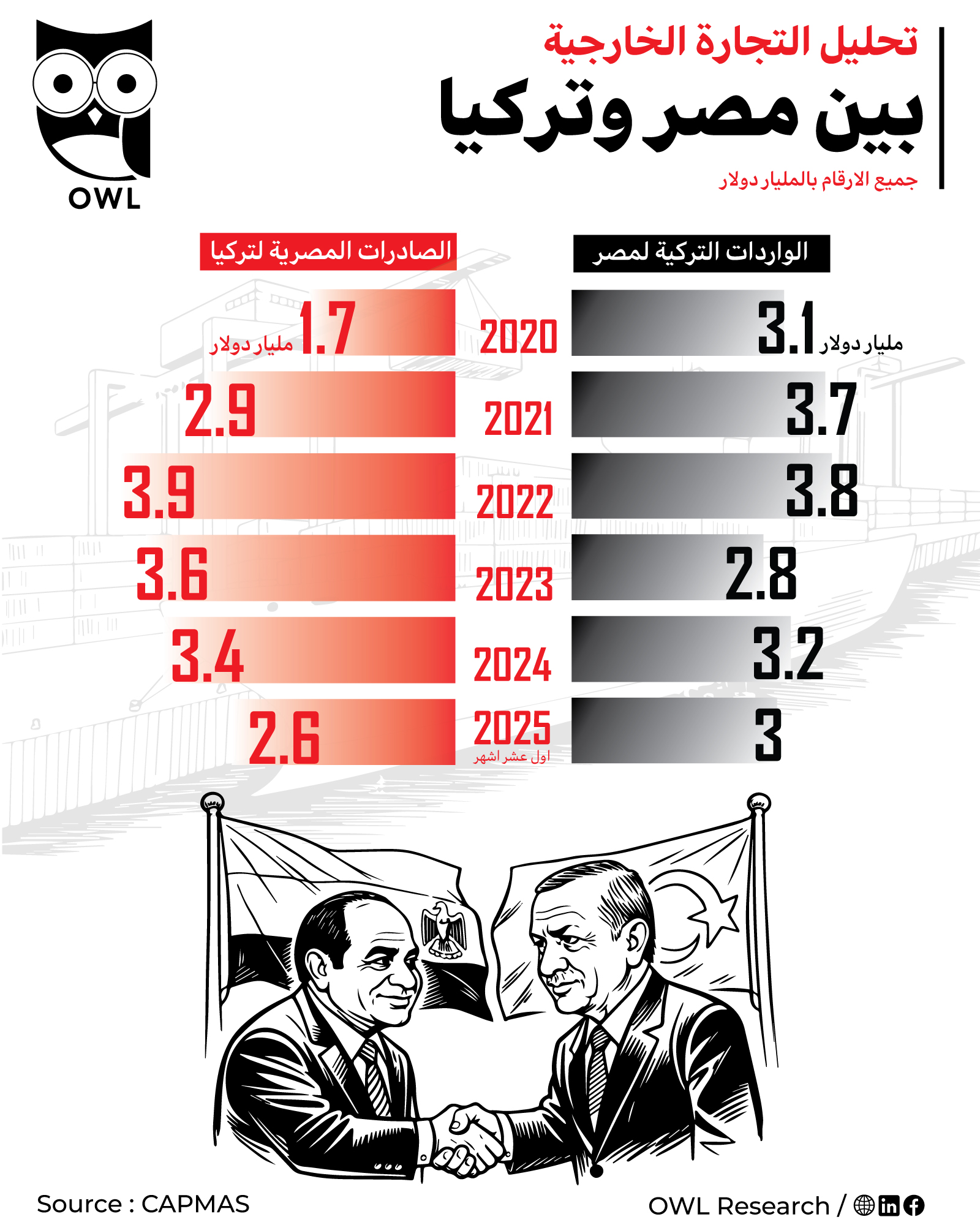
Egyptian Exports to Turkey: A Rising Trend with Recent Pressure
Egyptian exports to Turkey grew steadily between 2020 and 2022, before showing signs of moderation in the following years.
- 2020: Exports stood at USD 1.7bn, reflecting subdued trade activity amid global disruptions.
- 2021: Exports increased sharply to USD 2.9bn, supported by recovering global demand.
- 2022: Exports peaked at USD 3.9bn, marking the strongest performance in the period.
- 2023: A slight pullback to USD 3.6bn, as cost pressures and market adjustments emerged.
- 2024: Exports eased further to USD 3.4bn.
- 2025 (first ten months): Exports reached USD 2.6bn, indicating a softer pace compared to previous years.
Overall, despite recent moderation, Egyptian exports to Turkey remain structurally higher than pre-2021 levels.
Turkish Imports into Egypt: Volatility and Adjustment
Imports from Turkey into Egypt followed a more volatile trajectory, reflecting both demand-side shifts and currency-related factors.
- 2020: Imports amounted to USD 3.1bn.
- 2021: Increased to USD 3.7bn as trade normalized post-pandemic.
- 2022: Reached USD 3.8bn, the highest level in the period.
- 2023: Declined sharply to USD 2.8bn, amid import controls and FX constraints.
- 2024: Recovered modestly to USD 3.2bn.
- 2025 (first ten months): Imports stood at USD 3.0bn, signaling relative stabilization.
Trade Balance: Narrowing the Gap
The data highlights a clear improvement in Egypt’s trade position with Turkey over time. While Egypt historically ran a trade deficit with Turkey, the gap narrowed significantly during 2022–2024 as exports expanded faster than imports.
This trend reflects:
- Improved competitiveness of Egyptian industrial and intermediate goods.
- Shifts in sourcing strategies within regional supply chains.
- Policy-driven adjustments affecting imports.
Key Takeaways
- Egypt–Turkey trade volumes remain resilient despite recent global and regional pressures.
- Egyptian exports to Turkey have structurally strengthened since 2021.
- Import volatility underscores the impact of FX availability and domestic demand management.
- The bilateral trade relationship is moving toward a more balanced structure compared to earlier years.
As economic cooperation deepens and investment ties expand, trade flows between Egypt and Turkey are likely to remain a key indicator of broader regional economic integration.