Agriculture remains one of the most critical yet underleveraged sectors across Africa. Recent data highlights a compelling reality: a handful of African countries dominate in terms of arable land, positioning the continent as a future global food hub—if properly utilized.
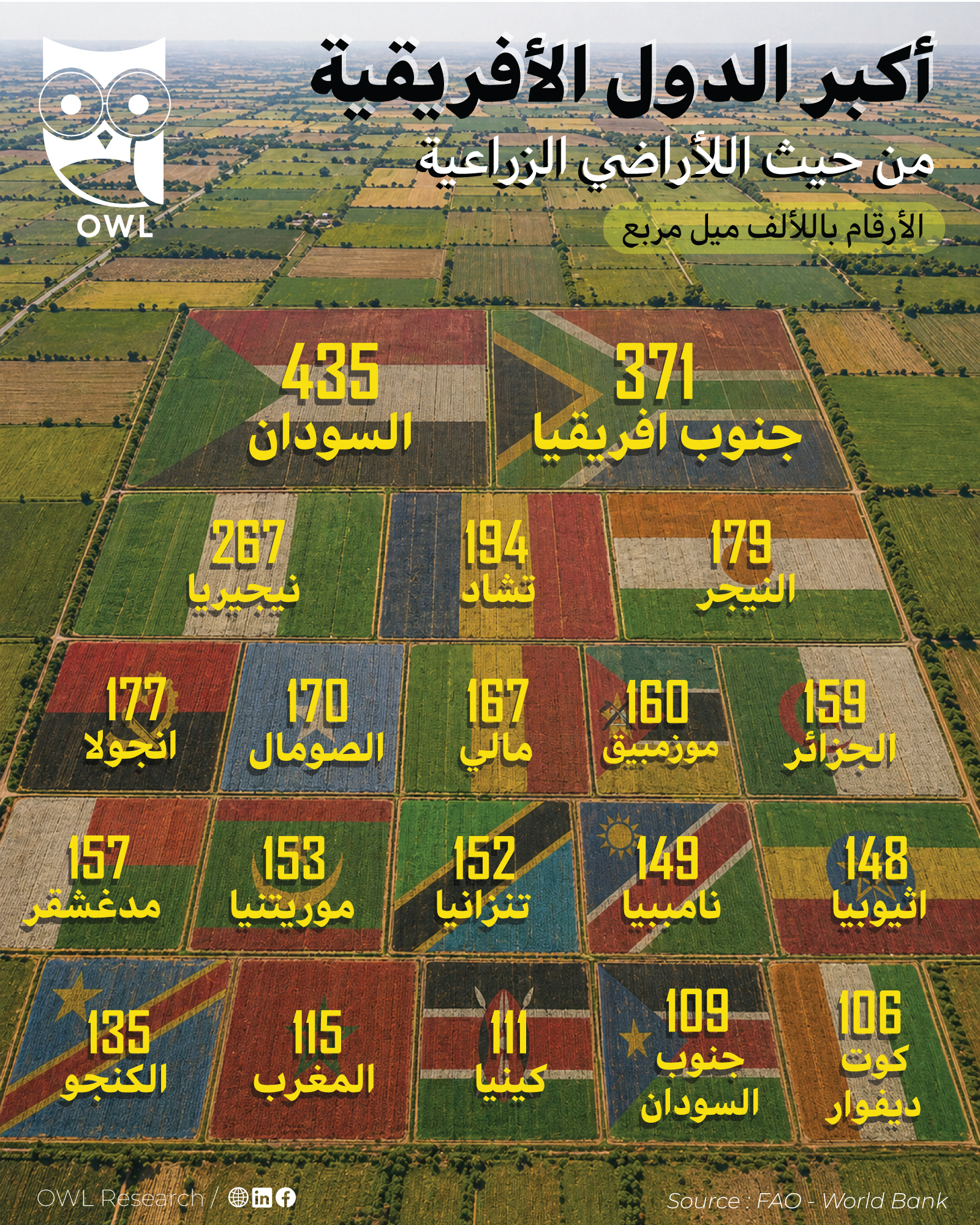
Top African Countries by Agricultural Land
Based on FAO and World Bank estimates (in thousand square miles), the leading countries include:
- Sudan: 435
- South Africa: 371
- Nigeria: 267
- Chad: 194
- Niger: 179
- Angola: 177
- Somalia: 170
- Mali: 167
- Mozambique: 160
- Algeria: 159
Followed by Madagascar, Mauritania, Tanzania, Namibia, Ethiopia, DR Congo, Morocco, Kenya, South Sudan, and Côte d’Ivoire.
Sudan Leads—But Why?
Sudan’s position at the top is not surprising. The country benefits from:
1. Vast Land Availability
Large, relatively flat areas suitable for cultivation.
2. Nile Water Access
A strategic irrigation advantage compared to many African peers.
3. Low Population Density (Relative to Land Size)
Creating an opportunity for expansion rather than overutilization.
However, land size alone does not equal productivity.
Key Insight: Land ≠ Output
Despite Africa’s vast agricultural land, the continent still faces food security challenges. This gap highlights a fundamental issue:
The constraint is not land availability—it’s productivity, infrastructure, and systems.
Key barriers include:
- Limited irrigation systems
- Low mechanization
- Supply chain inefficiencies
- Political and economic instability
Strategic Opportunity for Africa
From a global perspective, Africa holds a unique position:
- Rising global food demand
- Climate pressure on traditional agricultural regions
- Increasing need for sustainable food systems
This positions Africa not just as a regional player—but as a future global agricultural engine.
What Needs to Change?
To unlock this potential, focus must shift toward:
1. Investment in Agri-Tech
Precision farming, irrigation, and data-driven agriculture.
2. Infrastructure Development
Storage, logistics, and distribution networks.
3. Policy & Stability
Creating an environment that attracts long-term investment.
4. Value Chain Integration
Moving beyond raw production into processing and exports.
Key Takeaway
Africa’s agricultural story is not about scarcity—it’s about underutilized abundance.
For investors, governments, and businesses, the real opportunity lies in transforming land into productive, scalable, and sustainable systems.