Remittances from Egyptians working abroad continue to play a vital role in supporting Egypt’s economy, foreign currency reserves, and household consumption.
According to data from the Central Bank of Egypt (CBE) analyzed by OWL Research, remittances from Egyptians abroad reached USD 3.8 billion in February 2026, maintaining the strong performance recorded throughout the previous year.
The latest figures highlight the sustained recovery of remittance inflows following Egypt’s economic reforms and exchange rate liberalization, which have encouraged greater use of formal banking channels.
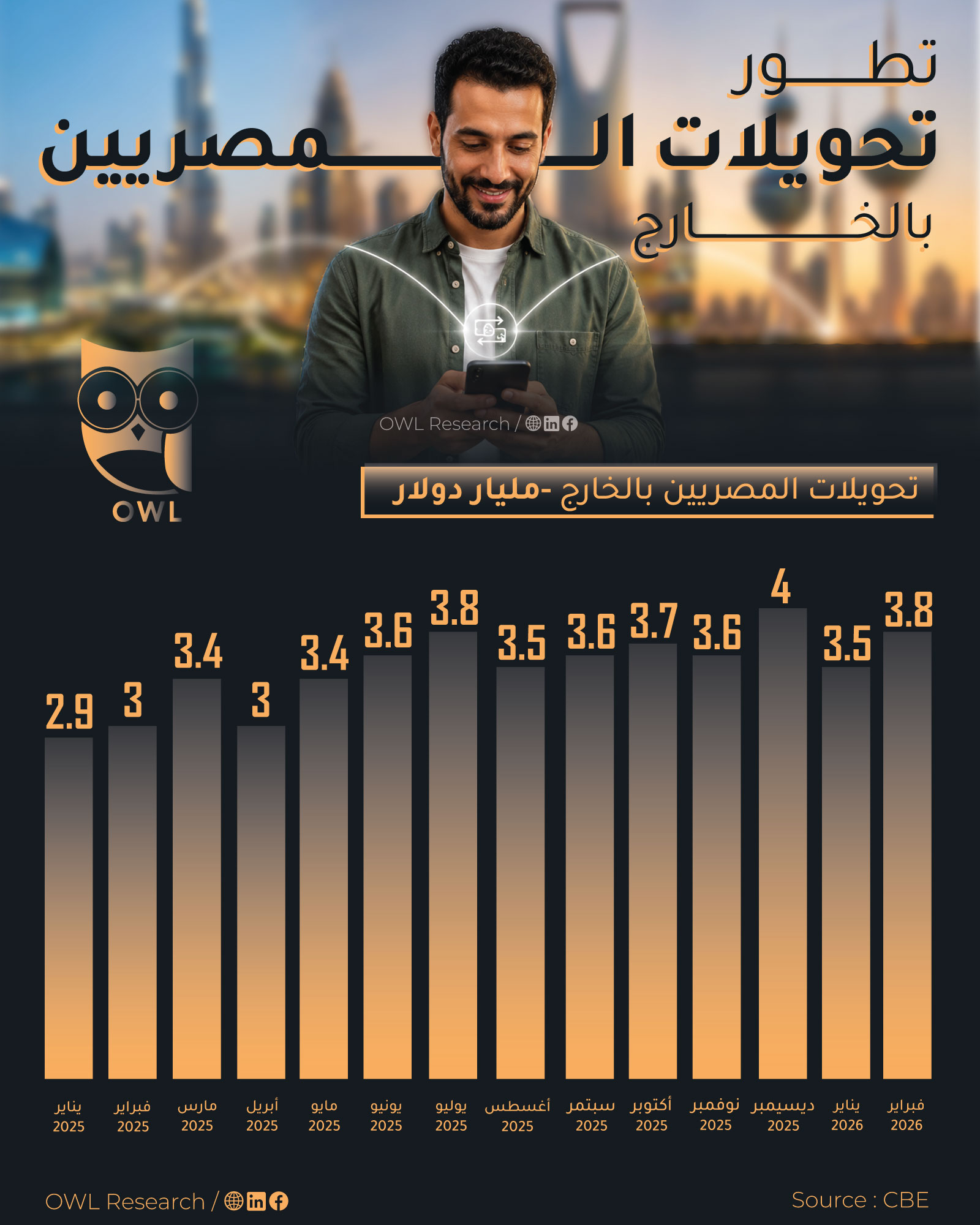
Monthly Evolution of Egyptian Remittances
The trend over the past fourteen months demonstrates remarkable stability, with monthly remittance inflows consistently exceeding USD 3 billion.
| Month | Remittances (USD Billion) |
|---|---|
| January 2025 | 2.9 |
| February 2025 | 3.0 |
| March 2025 | 3.4 |
| April 2025 | 3.0 |
| May 2025 | 3.4 |
| June 2025 | 3.6 |
| July 2025 | 3.8 |
| August 2025 | 3.5 |
| September 2025 | 3.6 |
| October 2025 | 3.7 |
| November 2025 | 3.6 |
| December 2025 | 4.0 |
| January 2026 | 3.5 |
| February 2026 | 3.8 |
The data shows a clear upward trend compared to early 2025 levels, with remittances stabilizing around USD 3.5–4.0 billion per month.
Key Insights from OWL Research
1. Remittances Remain a Major Source of Foreign Currency
With monthly inflows approaching USD 4 billion, remittances continue to rank among Egypt’s most important sources of foreign exchange alongside exports, tourism revenues, Suez Canal receipts, and foreign direct investment.
2. Formal Transfer Channels Continue to Gain Share
The sustained growth in remittances suggests increasing confidence in the official banking system, supported by exchange rate reforms and improved availability of foreign currency through formal channels.
3. Strong Seasonal Patterns Persist
The highest monthly inflow during the period was recorded in December 2025, reaching USD 4 billion, likely reflecting year-end transfers and increased family support spending during holiday periods.
4. Recovery Appears Structural Rather Than Temporary
Unlike short-term spikes, remittances have remained elevated for several consecutive months, indicating a structural shift toward higher and more stable inflows.
Why Egyptian Remittances Matter
Remittances have a direct impact on several areas of the Egyptian economy:
Supporting Household Income
Millions of Egyptian families rely on transfers from relatives working abroad to finance daily expenses, education, healthcare, and housing.
Strengthening Foreign Exchange Liquidity
Higher remittance inflows contribute to increased foreign currency availability within the banking sector, helping stabilize financial markets.
Supporting Domestic Consumption
Funds received by households often flow into consumption, investment, and small business activities, creating multiplier effects across the economy.
Enhancing Economic Resilience
During periods of global uncertainty, remittances have historically served as one of Egypt’s most stable external income sources.
Outlook for 2026
If current trends continue, Egypt could record another strong year for remittance inflows in 2026.
Several factors may support continued growth:
- Stable exchange rate conditions
- Increased use of official transfer channels
- Growth in the Egyptian expatriate workforce abroad
- Ongoing digitalization of cross-border payment systems
- Strong labor demand in Gulf Cooperation Council (GCC) markets
While global economic conditions remain a key variable, current data suggests that remittances will continue to provide substantial support to Egypt’s external accounts and overall economic stability.
Conclusion
The latest data confirms that Egyptian expatriate remittances remain one of the strongest pillars of the country’s foreign currency inflows. With transfers reaching USD 3.8 billion in February 2026 and maintaining levels significantly above early 2025, the sector continues to demonstrate resilience and growing confidence in formal financial channels.
For policymakers, investors, and financial institutions, remittance trends remain an important indicator of Egypt’s external financial position and economic momentum.
About OWL Research
OWL Research delivers data-driven economic intelligence, market analysis, and consumer insights across Egypt and the MENA region. Through rigorous research and visualization, OWL Research helps businesses and decision-makers transform data into actionable insights.
Keywords: Egypt Remittances, Egyptian Expatriates, Foreign Currency Inflows Egypt, Central Bank of Egypt, Egyptian Economy 2026, Overseas Egyptians, Remittance Growth Egypt, Foreign Exchange Egypt, Economic Indicators Egypt, OWL Research.