The U.S. dollar remains the dominant currency in global foreign exchange reserves, accounting for more than half of the world’s allocated reserves in the first quarter of 2026.
According to International Monetary Fund (IMF) data, global foreign exchange reserves reached approximately USD 13.1 trillion in Q1 2026 across the currencies presented, with the U.S. dollar maintaining a significant lead over the euro and other major reserve currencies.
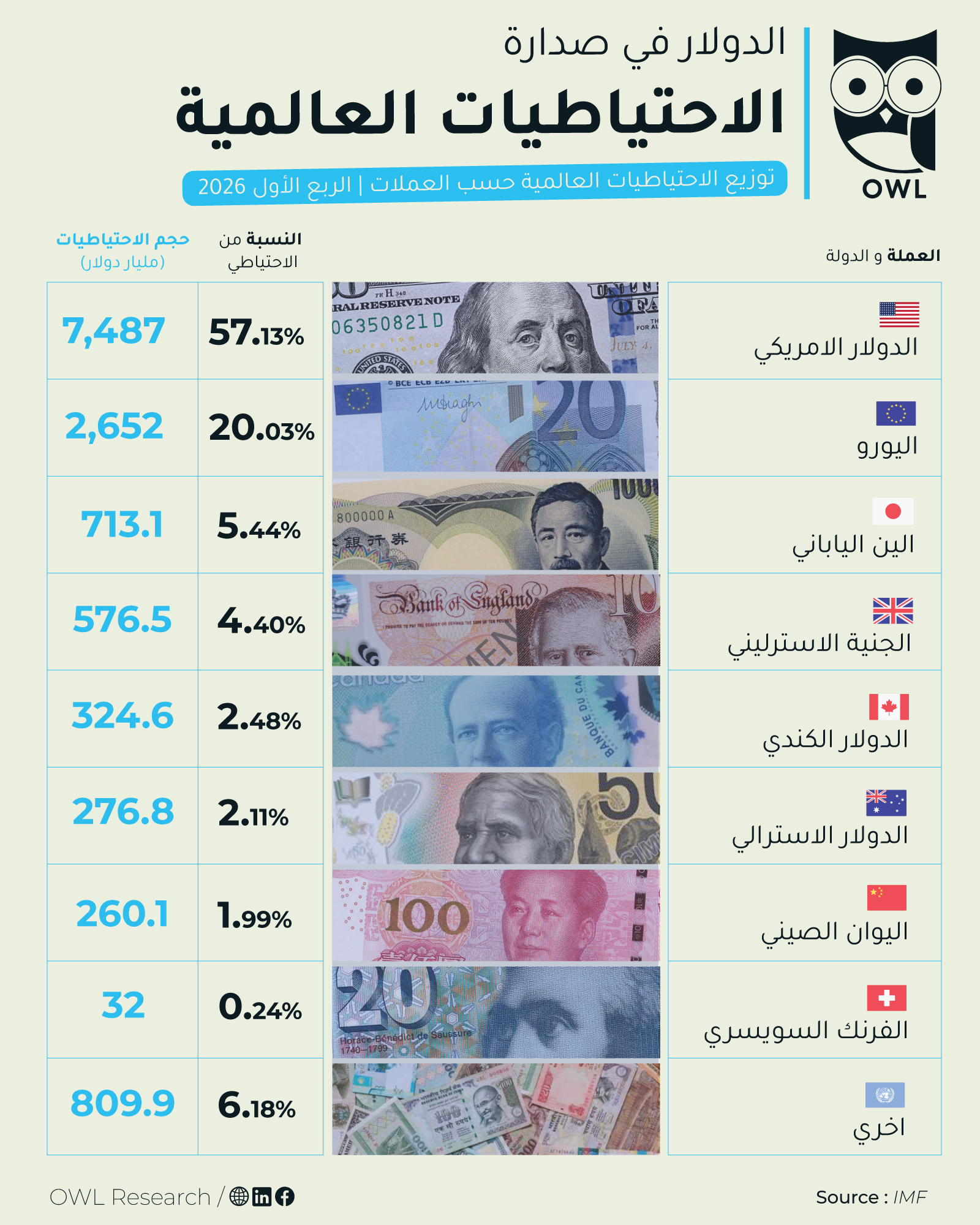
The U.S. Dollar Holds the Largest Share
The U.S. dollar accounted for 57.13% of global foreign exchange reserves, equivalent to approximately USD 7.49 trillion.
This places the dollar well ahead of the other major reserve currencies and highlights its continued role at the center of the international monetary and financial system.
The euro ranked second, representing 20.03% of global reserves, with holdings of approximately USD 2.65 trillion.
Together, the U.S. dollar and euro accounted for more than 77% of the reserves shown, underlining the concentration of global reserve assets in the two currencies.
Japan, the UK and Canada Follow
The remaining major reserve currencies represented considerably smaller shares:
- Japanese Yen: USD 713.1 billion, or 5.44%
- Pound Sterling: USD 576.5 billion, or 4.40%
- Canadian Dollar: USD 324.6 billion, or 2.48%
- Australian Dollar: USD 276.8 billion, or 2.11%
- Chinese Yuan: USD 260.1 billion, or 1.99%
- Swiss Franc: USD 32.0 billion, or 0.24%
Other currencies collectively accounted for approximately 6.18%, equivalent to USD 809.9 billion.
Where Does the Chinese Yuan Stand?
One of the notable figures in the latest data is the share of the Chinese yuan, which represented 1.99% of global reserves, equivalent to approximately USD 260.1 billion.
Despite China’s significant role in global trade, the yuan’s share of official foreign exchange reserves remains considerably smaller than that of the U.S. dollar and euro.
The data illustrates an important distinction between a currency’s role in international trade and its role as a reserve asset held by central banks.
Reserve Currencies Reflect Global Financial Confidence
Foreign exchange reserves are assets held by central banks and monetary authorities to support international payments, manage external financial risks and provide liquidity when needed.
The composition of these reserves can provide insight into the structure of the global financial system.
Currencies used widely in international trade, financial markets and cross-border transactions can play an important role in central-bank reserve portfolios.
However, reserve allocation is influenced by several factors, including market liquidity, financial-market depth, currency stability, international payment networks and the availability of suitable financial assets.
A Highly Concentrated Reserve System
The figures show that global reserves remain highly concentrated among a relatively small number of currencies.
The U.S. dollar alone represents 57.13% of the reserves shown, while the euro accounts for another 20.03%.
By comparison, the Chinese yuan represents 1.99%, while the Swiss franc accounts for just 0.24%.
This distribution highlights the different roles that major currencies currently play within the international monetary system.
The Bigger Picture
The composition of global foreign exchange reserves is closely watched by economists, investors, central banks and policymakers because changes in reserve allocation can provide signals about longer-term developments in international finance.
At the same time, quarterly movements should be interpreted carefully. Changes in reserve shares can result from currency valuation effects, changes in reserve holdings and shifts in central-bank asset allocation, rather than simply reflecting a change in the underlying preference for a particular currency.
Tracking the data over multiple quarters therefore provides a more complete picture of how the international reserve system is evolving.
Key Takeaway
The U.S. dollar accounted for 57.13% of global foreign exchange reserves in Q1 2026, equivalent to approximately USD 7.49 trillion, maintaining a substantial lead over the euro at 20.03%.
The figures also show that while several currencies contribute to the global reserve system, reserve holdings remain concentrated around a small group of major international currencies.