How the United States and Iran account for the majority of military drone transfers worldwide
Military drones have transformed modern warfare, becoming essential tools for surveillance, reconnaissance, precision strikes, and battlefield operations. What was once a specialized military capability has evolved into a rapidly expanding dimension of global defence competition.
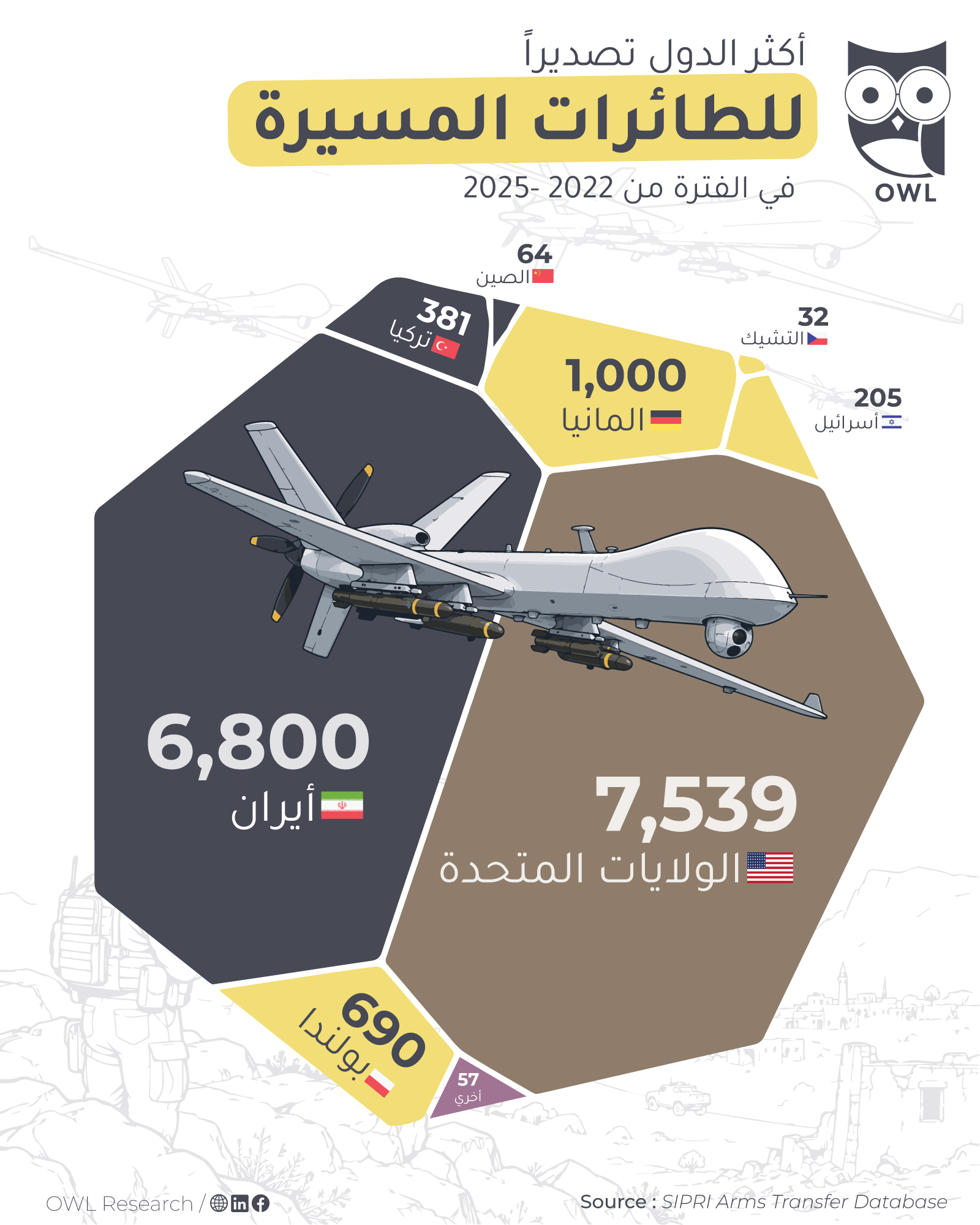
Between 2022 and 2025, international military drone transfers revealed a highly concentrated market, dominated by two countries: the United States and Iran.
According to data from the Stockholm International Peace Research Institute (SIPRI), these two countries accounted for approximately 86% of recorded military drone transfers during the period, highlighting how concentrated the global supply of these systems has become.
But beyond the headline figures, the rankings reveal a deeper story about military technology, geopolitical alliances, and the changing structure of the global defence industry.
The United States: The World’s Largest Military Drone Supplier
With approximately 7,593 military drones supplied between 2022 and 2025, the United States ranks first among global exporters.
Its position reflects its extensive defence industrial base and its ability to supply advanced military systems at scale.
American military drone transfers during this period were heavily concentrated in Ukraine, which received approximately 95% of US deliveries recorded in the dataset.
This illustrates how military assistance and geopolitical commitments can significantly influence international arms transfer rankings.
The United States remains a major player in unmanned military aviation, supported by its advanced aerospace industry, defence contractors, and extensive military technology ecosystem.
Iran: A Major Supplier in the Global Drone Trade
Iran ranks second, with approximately 6,800 military drones supplied during the same period.
Despite having a significantly smaller defence industrial base than the United States, Iran has emerged as an important supplier of relatively low-cost, one-way attack drones.
Approximately 99% of Iran’s recorded deliveries went to Russia, primarily involving Shahed-136 drones.
These systems have attracted international attention because of their role in the Russia-Ukraine war and their relatively low production costs compared with many conventional precision-guided weapons.
Iran’s position demonstrates how relatively inexpensive military technologies can become strategically influential when produced and supplied at scale.
Germany and Poland: European Suppliers Enter the Rankings
Germany ranks third, with approximately 1,000 military drones supplied, followed by Poland with 690.
Their presence highlights Europe’s role in the expanding military drone supply chain.
While Germany benefits from an established aerospace and defence manufacturing sector, Poland’s growing defence capabilities reflect its changing security priorities and its position within Europe’s evolving military landscape.
The two countries illustrate how European defence industries are becoming increasingly relevant amid rising regional security concerns.
Türkiye: Fewer Drones, Wider International Reach
Türkiye supplied approximately 381 military drones between 2022 and 2025, placing it fifth in the ranking.
However, the country’s influence extends beyond the number of systems delivered.
Turkish drone manufacturers, particularly Baykar, have developed a strong international presence through platforms such as the Bayraktar TB2.
Türkiye supplied military drones to 28 countries, demonstrating a broad export network despite its relatively smaller delivery volume compared with the United States and Iran.
This distinction highlights an important difference between export volume and international market reach.
Other Countries: A More Limited Share of Global Transfers
The remaining exporters recorded substantially smaller delivery volumes:
- Israel: 205 drones.
- China: 64 drones.
- Czechia: 32 drones.
- Other suppliers: smaller quantities.
Although their combined contribution is considerably smaller, these countries remain relevant to the wider military technology ecosystem through specialized manufacturing capabilities, defence innovation, and regional export relationships.
China, in particular, maintains a significant role in the broader global unmanned systems market, although the figures presented here cover only the military systems included in SIPRI’s database.
What Do These Numbers Tell Us About the Future of Warfare?
The distribution of military drone transfers reveals three important developments.
1. The market is highly concentrated
The United States and Iran together account for approximately 86% of recorded military drone deliveries in the period. This concentration demonstrates the influence of a small number of suppliers in shaping the global availability of these systems.
2. Low-cost weapons are changing military capabilities
One-way attack drones and loitering munitions represent approximately 97% of the recorded global total. Their relatively low cost and ability to be deployed in large numbers have changed the economics of modern warfare.
3. Export reach matters as much as delivery volume
Türkiye provides an important example of how a country can build international defence influence through a diversified customer base, even without matching the delivery volumes of the largest suppliers.
The Bottom Line
The global military drone market is becoming an increasingly important component of international defence competition.
The United States leads in recorded delivery volumes, Iran has established itself as a major supplier of one-way attack drones, Germany and Poland represent growing European contributions, and Türkiye has built a wide international export network.
Ultimately, the competition is no longer simply about who can manufacture the most drones. It is about who can develop effective systems, produce them at scale, establish international partnerships, and translate technological capabilities into strategic influence.
As unmanned systems become more deeply integrated into modern warfare, control over drone technology and supply chains is likely to remain a defining element of global military competition.