Households Lead Electricity Demand, While Industry Accounts for More Than a Quarter of National Consumption
Electricity is one of the most important inputs driving economic activity. From household appliances and industrial production to commercial establishments and public infrastructure, power consumption offers an important perspective on how an economy operates.
In Egypt, electricity consumption is distributed across a diverse range of sectors, with households and industrial activities accounting for the largest shares.
Data for fiscal year 2024/2025 reveals an interesting picture of the country’s electricity demand, highlighting the growing importance of residential consumption alongside the energy requirements of productive and public-sector activities.
Households: The Largest Electricity Consumer
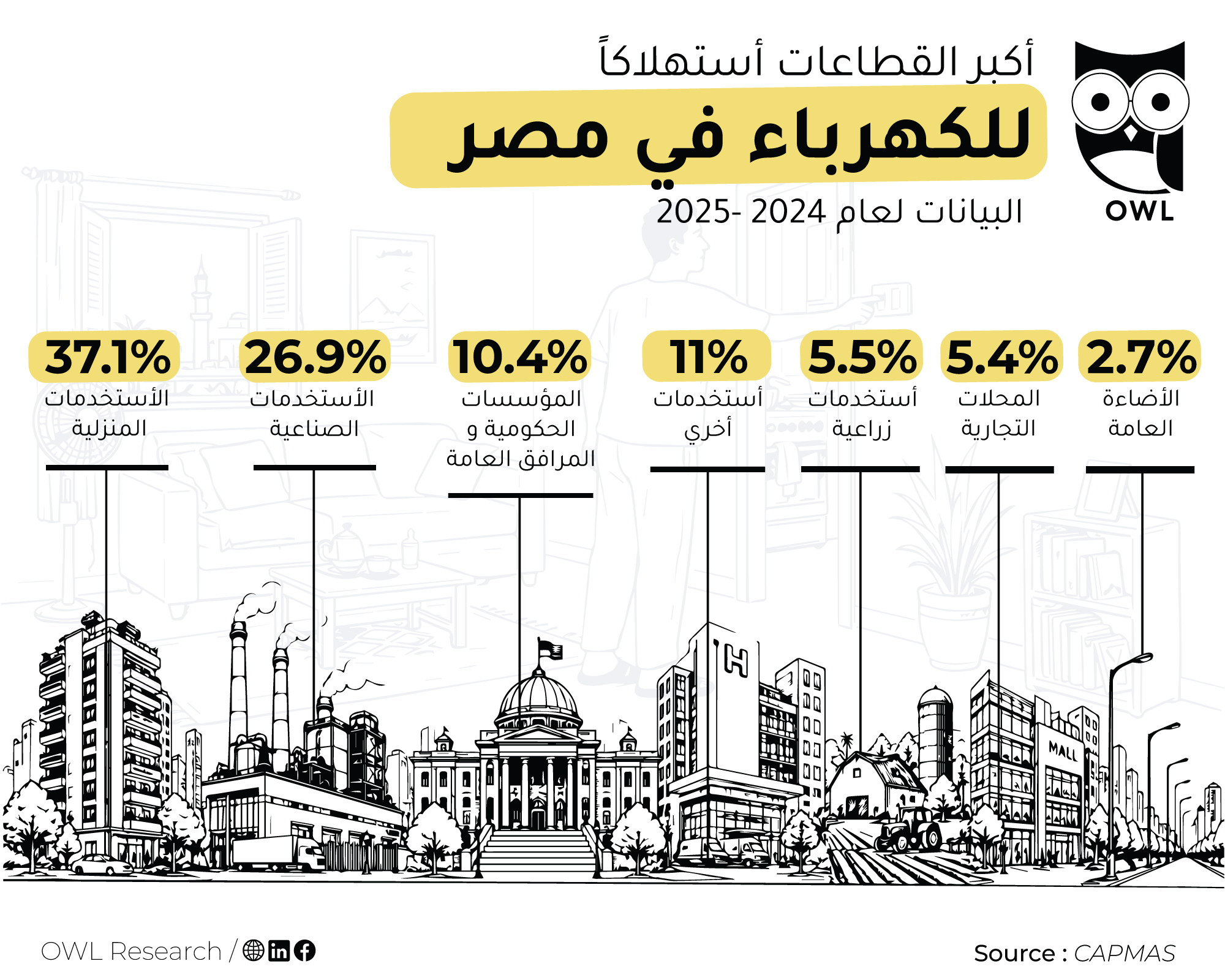
Household consumption represents the largest share of electricity demand in Egypt, accounting for 37.1% of total consumption.
This reflects the substantial electricity requirements of residential activities, including lighting, air conditioning, refrigeration, household appliances, and other everyday needs.
Population growth, urban expansion, and changing consumption patterns all contribute to the importance of residential demand within the national electricity system.
The dominance of household consumption also highlights the importance of energy efficiency initiatives and responsible electricity usage in managing overall demand.
Industry: A Major Driver of Electricity Demand
Industrial activities account for 26.9% of Egypt’s electricity consumption, making the sector the second-largest consumer.
Electricity plays a critical role in supporting manufacturing operations, machinery, production lines, and industrial infrastructure.
The sector’s substantial share reflects the energy requirements of Egypt’s productive economy, where reliable electricity supply is essential for maintaining industrial output and supporting economic expansion.
As industrial activity develops, improving energy efficiency and modernizing production technologies will become increasingly important in managing electricity demand.
Government Institutions and Public Utilities
Government institutions and public utilities account for 10.4% of total electricity consumption.
This category includes electricity used across government facilities and public infrastructure, reflecting the energy requirements of public administration and essential services.
Efficient energy management across public buildings and utilities can contribute to reducing operational costs while improving the sustainability of public services.
Other Uses: An Important Share of National Demand
Other electricity uses represent approximately 11% of total consumption, making this one of the significant components of Egypt’s electricity demand.
This category captures consumption that falls outside the separately identified household, industrial, agricultural, commercial, and government segments.
Its contribution highlights the diversity of electricity requirements across the wider economy.
Agriculture: Powering the Productive Sector
Agricultural activities account for 5.5% of electricity consumption.
Electricity supports several agricultural operations, particularly irrigation systems, water pumping, storage facilities, and agricultural processing.
As Egypt continues to prioritize agricultural development and food security, reliable electricity access remains an important component of supporting agricultural productivity.
Commercial Activities and Public Lighting
Commercial establishments account for 5.4% of electricity consumption, reflecting the power requirements of retail stores, businesses, and other commercial activities.
Meanwhile, public lighting represents 2.7%, covering electricity used for street lighting and other public lighting infrastructure.
Although these categories account for smaller shares of national consumption, they remain essential to the operation of Egypt’s commercial environment and urban infrastructure.
What Do These Numbers Tell Us About Egypt’s Electricity Demand?
The distribution of electricity consumption reveals three important insights about Egypt’s energy landscape.
1. Residential demand remains the biggest pressure point
With households accounting for 37.1% of electricity consumption, residential usage represents the largest single component of national demand. This makes household energy efficiency an important factor in managing future electricity requirements.
2. Industry remains central to the country’s energy needs
The industrial sector’s 26.9% share demonstrates the close relationship between electricity supply and productive economic activity. Maintaining reliable power while improving industrial efficiency will be essential to supporting manufacturing competitiveness.
3. Electricity demand extends beyond households and factories
Government institutions, agriculture, commercial establishments, public lighting, and other activities collectively represent a substantial share of electricity consumption. This reinforces the importance of an integrated approach to energy planning across the economy.
The Bottom Line
Egypt’s electricity consumption reflects the demands of both everyday life and economic production.
Households account for the largest share, followed by industry, while government institutions, agriculture, commercial activities, and public infrastructure contribute to the country’s wider electricity requirements.
As electricity demand continues to evolve, the challenge will not simply be to expand generation capacity, but to improve efficiency, optimize consumption, and ensure that electricity resources support sustainable economic growth.
Understanding who consumes electricity is the first step toward understanding where Egypt’s energy system needs to go next.