Railway safety remains an important public policy and infrastructure challenge in Egypt. With one of the country’s largest public transportation networks, the railway system plays a vital role in connecting cities, supporting economic activity, and transporting millions of passengers every year.
However, railway accidents continue to raise concerns about operational safety, infrastructure reliability, and the protection of passengers and railway workers.
Data published by Egypt’s Central Agency for Public Mobilization and Statistics (CAPMAS) provides an overview of how railway accidents, fatalities, and injuries have evolved between 2020 and 2025.
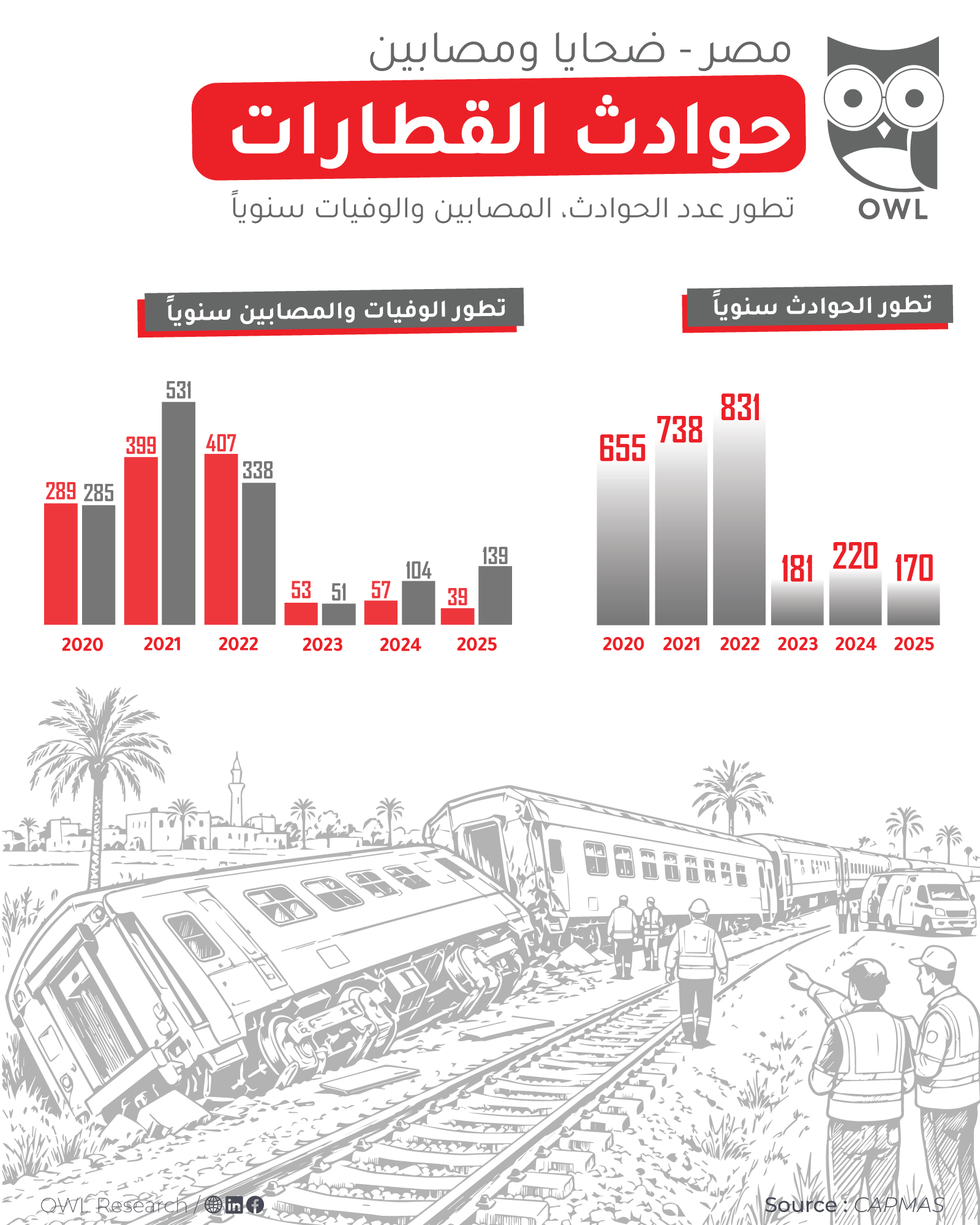
Railway Accidents: A Six-Year Overview
The reported number of railway accidents shows considerable variation over the period.
According to the figures presented in the CAPMAS-based dataset, the annual number of railway accidents was:
- 2020: 655 accidents
- 2021: 738 accidents
- 2022: 831 accidents
- 2023: 181 accidents
- 2024: 220 accidents
- 2025: 170 accidents
The number of recorded accidents reached its highest level in 2022, at 831 incidents. It subsequently declined to 181 in 2023, before increasing to 220 in 2024.
In 2025, the number fell again to 170, representing a 22.7% decrease compared with the previous year.
This latest decline is a positive development in the reported accident figures. Nevertheless, changes in statistical classification and reporting should be considered when comparing long-term trends, particularly between 2022 and 2023.
Fatalities and Injuries: The Human Impact
Beyond the number of accidents, their human consequences provide another important measure of railway safety.
The infographic presents the following annual figures for fatalities and injuries:
| Year | Fatalities | Injuries |
|---|---|---|
| 2020 | 289 | 285 |
| 2021 | 399 | 531 |
| 2022 | 407 | 338 |
| 2023 | 53 | 51 |
| 2024 | 57 | 104 |
| 2025 | 39 | 139 |
The figures highlight several important developments.
2022 recorded the highest number of fatalities in the displayed series, with 407 deaths. In 2021, injuries reached their highest level, at 531 cases.
In 2025, reported fatalities declined to 39, compared with 57 in 2024, representing a decrease of approximately 31.6%.
However, injuries increased from 104 to 139 over the same period, equivalent to a rise of approximately 33.7%.
This contrast highlights why monitoring fatalities alone is insufficient. A comprehensive assessment of railway safety must consider both the frequency of accidents and their consequences.
2025: Fewer Accidents, but More Reported Injuries
The 2025 figures present a mixed picture.
While total railway accidents declined by 22.7%, and fatalities decreased by approximately 31.6%, reported injuries increased by 33.7%.
This suggests that improvements in one safety indicator do not necessarily translate into improvements across all dimensions of railway safety.
The nature and severity of individual incidents, passenger exposure, infrastructure conditions, and operational procedures all influence the final outcomes.
It is therefore important to examine multiple indicators rather than relying exclusively on the total number of accidents.
Beyond Train Accidents: The Wider Human Cost
An important distinction in CAPMAS statistics is the separation between accidents involving trains, incidents involving individuals on or near railway lines, and accidents involving railway authority employees.
In 2025, CAPMAS reported:
- 491 fatalities resulting from incidents involving individuals in connection with railway operations.
- 236 injuries in the same category.
- 5 fatalities and 215 injuries involving railway authority employees.
These figures demonstrate that railway safety extends beyond passengers travelling on trains. Pedestrians, individuals crossing railway tracks, and railway employees are also exposed to significant risks.
Consequently, improving railway safety requires a broader approach that addresses level crossings, track access, employee protection, signalling systems, and operational procedures.
What Do the Numbers Tell Us?
The six-year overview highlights three important observations:
- A significant decline in reported accidents: The annual total decreased from 831 in 2022 to 170 in 2025, although changes in statistical classification should be considered when interpreting this comparison.
- Fatalities declined in 2025: The reported number fell from 57 in 2024 to 39 in 2025.
- Injuries remain a concern: Despite fewer accidents, the number of reported injuries increased from 104 in 2024 to 139 in 2025.
Conclusion: Measuring Railway Safety Beyond Accident Numbers
Egypt’s railway safety performance should be evaluated through a combination of indicators, including accident frequency, fatalities, injuries, passenger exposure, and the safety of railway infrastructure.
The decline in reported accidents during 2025 represents an encouraging development. However, the simultaneous increase in injuries highlights the importance of continued investment in safety systems, maintenance, operational monitoring, and public awareness.
Ultimately, the effectiveness of railway modernization should not be measured only by the number of accidents avoided, but also by its ability to reduce human casualties and provide a safer transportation network for all users.