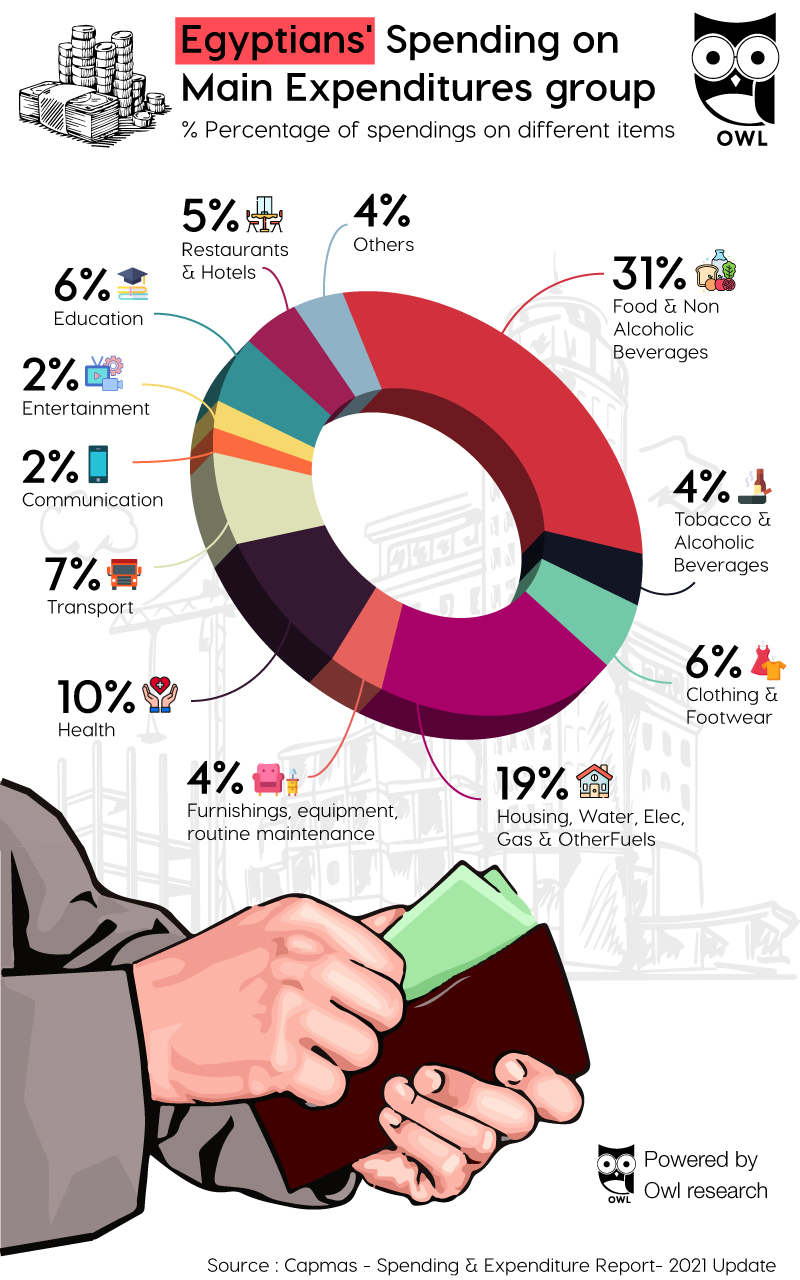
Understanding how households spend their income provides key insights into living standards, inflation pressures, and national economic priorities. According to CAPMAS – Spending & Expenditure Report 2021, Egyptians dedicate the majority of their income to food, housing, and healthcare, while smaller portions go toward education, transport, and entertainment.
1. Food and Beverages – 31%
The largest share of household spending goes to food and non-alcoholic beverages, making up 31% of total expenditures. This reflects the central role of food in household budgets and the impact of rising food prices on Egyptian families.
2. Housing, Utilities, and Fuel – 19%
The second largest spending category is housing, water, electricity, gas, and other fuels, representing 19% of household budgets. With ongoing increases in energy and utility costs, this segment is expected to remain a major financial burden for many families.
3. Healthcare – 10%
Healthcare consumes 10% of household income, reflecting both the importance of medical expenses and the growing reliance on private healthcare services.
4. Transport – 7%
Transportation costs account for 7% of spending, covering both public and private transport. Rising fuel prices have pushed this figure upward over recent years.
5. Education and Clothing – 6% Each
Education and clothing each represent 6% of total expenditures. Investment in education highlights the long-term priorities of Egyptian families, while clothing and footwear reflect seasonal and cultural spending habits.
6. Restaurants, Hotels, and Furnishings – 4–5%
- Restaurants & Hotels: 5%
- Furnishings, Equipment & Routine Maintenance: 4%
These discretionary expenses reflect middle-class spending and are more sensitive to economic conditions.
7. Other Categories
- Tobacco & Alcoholic Beverages: 4%
- Entertainment & Communication: 2% each
- Miscellaneous (Others): 4%
These smaller categories highlight how little is left for leisure and luxury after covering essentials.
Key Insights
- Essentials (food, housing, healthcare, and transport) take up over two-thirds of Egyptian household spending.
- Limited spending on entertainment (2%) and communication (2%) shows how constrained disposable income is.
- Rising costs of living continue to pressure families, especially in food and utilities.
Final Thoughts
The 2021 CAPMAS expenditure data shows that Egyptians spend the bulk of their income on necessities, leaving little for non-essential consumption. With 31% on food and 19% on housing, the Egyptian economy is highly sensitive to inflation in these categories. These spending patterns underline the importance of policies aimed at food security, energy subsidies, and healthcare support to ease the burden on households.