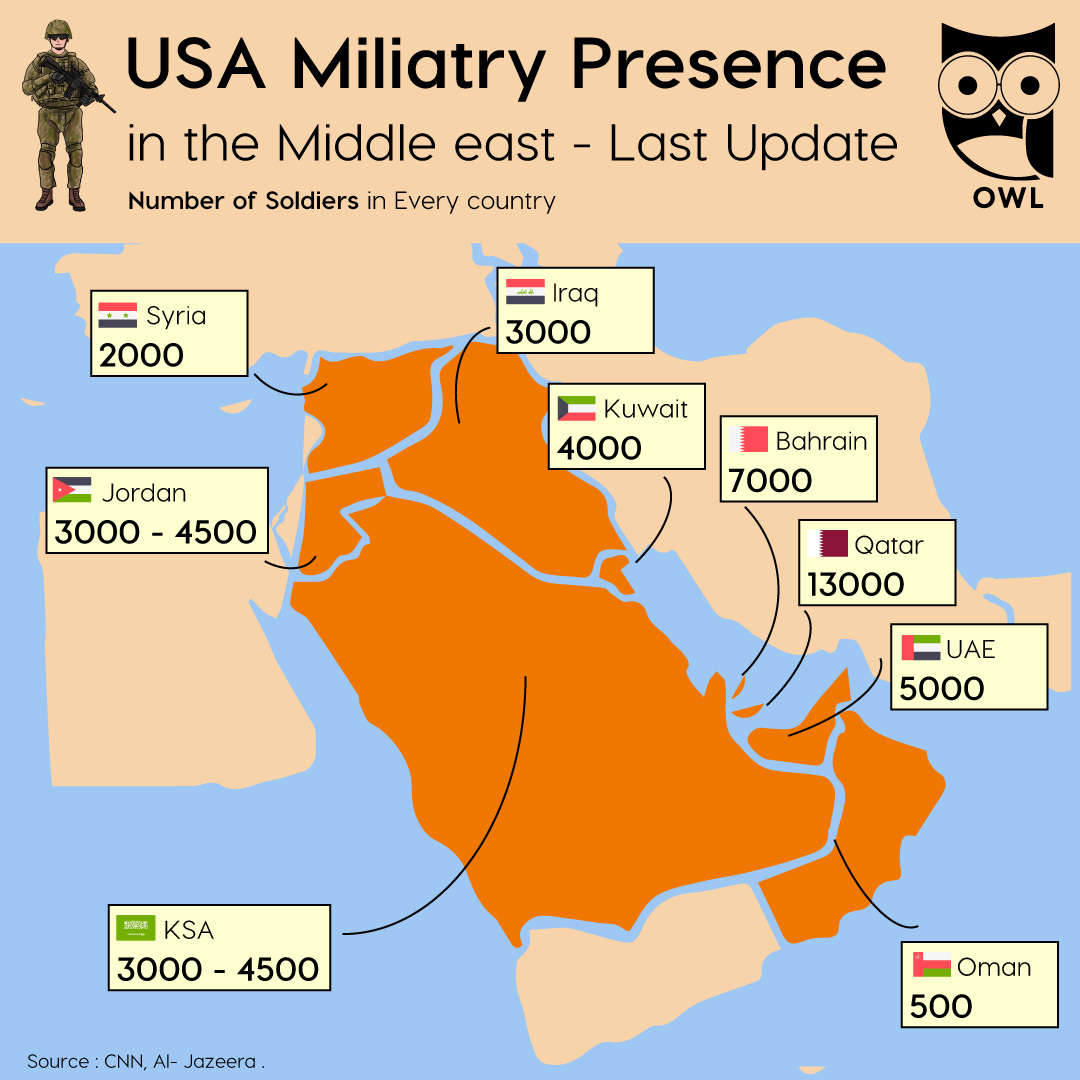
The United States maintains a significant military presence across the Middle East, reflecting its long-standing strategic, security, and economic interests in the region. According to the latest update, thousands of U.S. troops are stationed in multiple countries, supporting counterterrorism, regional stability, and defense cooperation with allies.
U.S. Troop Deployment by Country
- Qatar – 13,000 soldiers
Qatar hosts the largest U.S. military base in the region, Al Udeid Air Base, which plays a critical role in operations across the Middle East. - Bahrain – 7,000 soldiers
Bahrain is home to the U.S. Navy’s Fifth Fleet, ensuring maritime security in the Persian Gulf and the Strait of Hormuz. - United Arab Emirates (UAE) – 5,000 soldiers
The UAE cooperates closely with U.S. forces in air operations and counterterrorism efforts. - Kuwait – 4,000 soldiers
Kuwait serves as a strategic logistics hub for U.S. operations in Iraq and the wider region. - Saudi Arabia (KSA) – 3,000–4,500 soldiers
Troops in Saudi Arabia strengthen missile defense systems and regional deterrence strategies. - Jordan – 3,000–4,500 soldiers
U.S. forces in Jordan contribute to counterterrorism and border security operations, especially along the Syrian and Iraqi frontiers. - Iraq – 3,000 soldiers
U.S. troops remain in Iraq under advisory and support missions to assist local forces in combating terrorism. - Syria – 2,000 soldiers
The presence in Syria focuses on fighting remnants of ISIS and supporting Kurdish-led forces. - Oman – 500 soldiers
Oman hosts a smaller contingent that plays a role in maritime security and strategic monitoring.
Strategic Importance of U.S. Presence
The distribution of troops reflects key priorities for U.S. policy in the Middle East:
- Counterterrorism: Preventing the resurgence of extremist groups.
- Maritime Security: Safeguarding vital shipping lanes, especially in the Persian Gulf and Red Sea.
- Regional Stability: Supporting allies and deterring potential threats from Iran.
- Military Logistics: Using bases as launch points for operations across Asia and Africa.
Conclusion
The U.S. military presence in the Middle East remains a cornerstone of its foreign policy, ensuring influence over security dynamics and energy routes. With thousands of troops spread across Qatar, Bahrain, the UAE, Kuwait, Iraq, Syria, Saudi Arabia, Jordan, and Oman, the United States underscores its commitment to protecting allies and maintaining stability in one of the world’s most volatile regions.