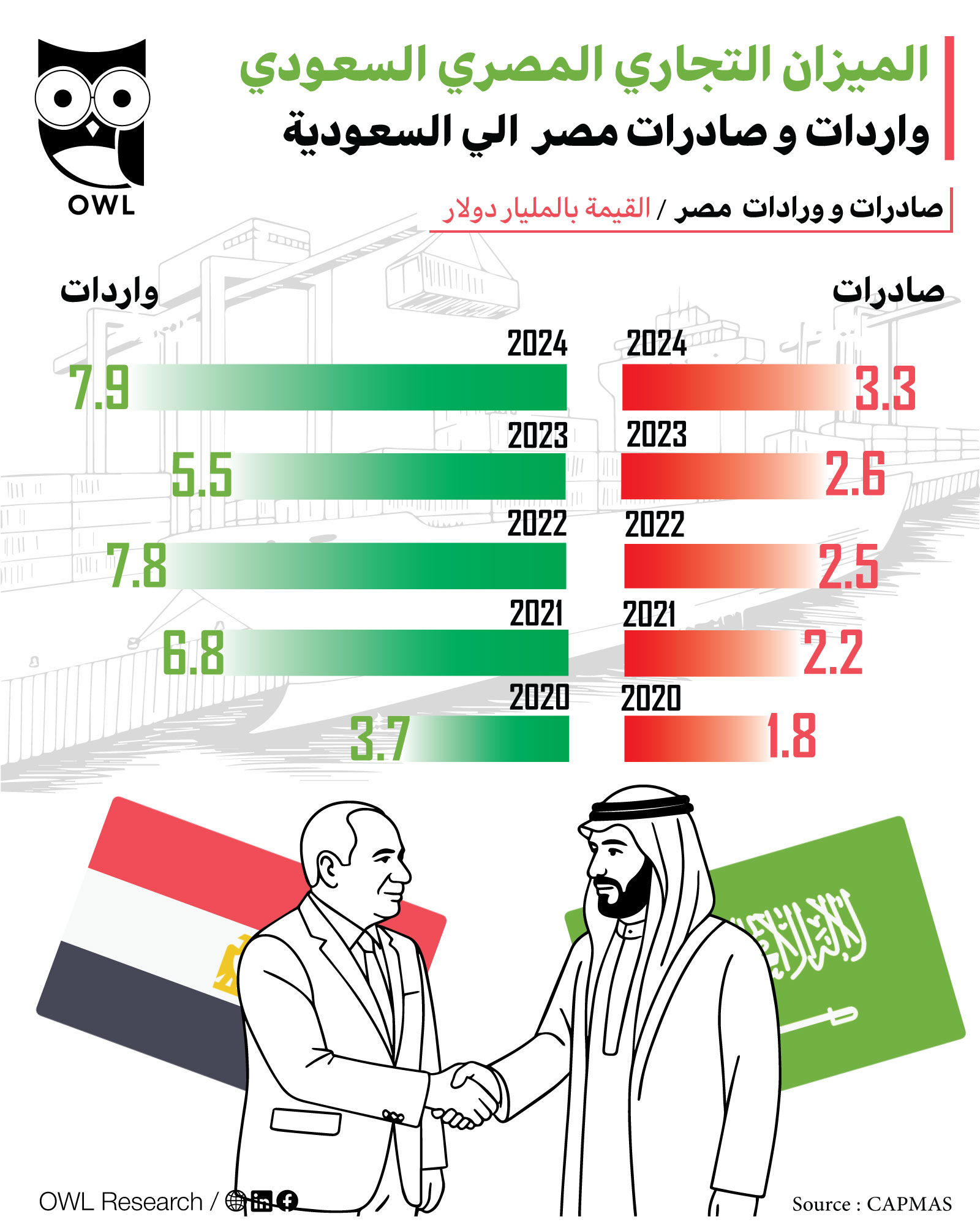
Trade relations between Egypt and Saudi Arabia represent one of the strongest bilateral economic ties in the Middle East. According to data from CAPMAS, trade flows between the two countries have grown significantly in recent years, though Egypt continues to run a trade deficit with the Kingdom.
Egypt’s Imports from Saudi Arabia (Billion USD)
- 2024: $7.9 billion
- 2023: $5.5 billion
- 2022: $7.8 billion
- 2021: $6.8 billion
- 2020: $3.7 billion
Imports are dominated by oil, petrochemicals, and related products, reflecting Saudi Arabia’s role as a global energy exporter.
Egypt’s Exports to Saudi Arabia (Billion USD)
- 2024: $3.3 billion
- 2023: $2.6 billion
- 2022: $2.5 billion
- 2021: $2.2 billion
- 2020: $1.8 billion
Egypt mainly exports food products, agricultural goods, building materials, and chemicals, with demand driven by Saudi Arabia’s growing population and ongoing Vision 2030 mega-projects.
Key Insights
1. Expanding Trade Volumes
Total trade between Egypt and Saudi Arabia grew steadily, with 2024 seeing the highest import levels ($7.9B) and exports ($3.3B) over the five-year period.
2. Persistent Trade Deficit
Despite export growth, Egypt consistently imports more from Saudi Arabia, resulting in a structural trade deficit. In 2024, the deficit stood at $4.6 billion.
3. Strategic Economic Partnership
Saudi Arabia is one of Egypt’s largest trade partners in the Arab world, and both countries continue to strengthen cooperation in energy, investment, and infrastructure.
Future Outlook
- Diversification of Exports: Egypt aims to expand into manufactured goods, processed foods, and services to reduce its trade imbalance.
- Energy and Petrochemicals: Imports from Saudi Arabia will likely remain strong, but renewable energy cooperation could balance ties in the future.
- Investment Links: Beyond trade, Saudi investments in Egypt’s real estate, tourism, and infrastructure will further deepen economic integration.
Conclusion
Between 2020 and 2024, Egypt–Saudi Arabia trade relations showed steady growth in both imports and exports, highlighting the importance of this partnership for regional stability and development. While Egypt continues to face a trade deficit, opportunities remain for greater economic collaboration under both countries’ long-term strategies.