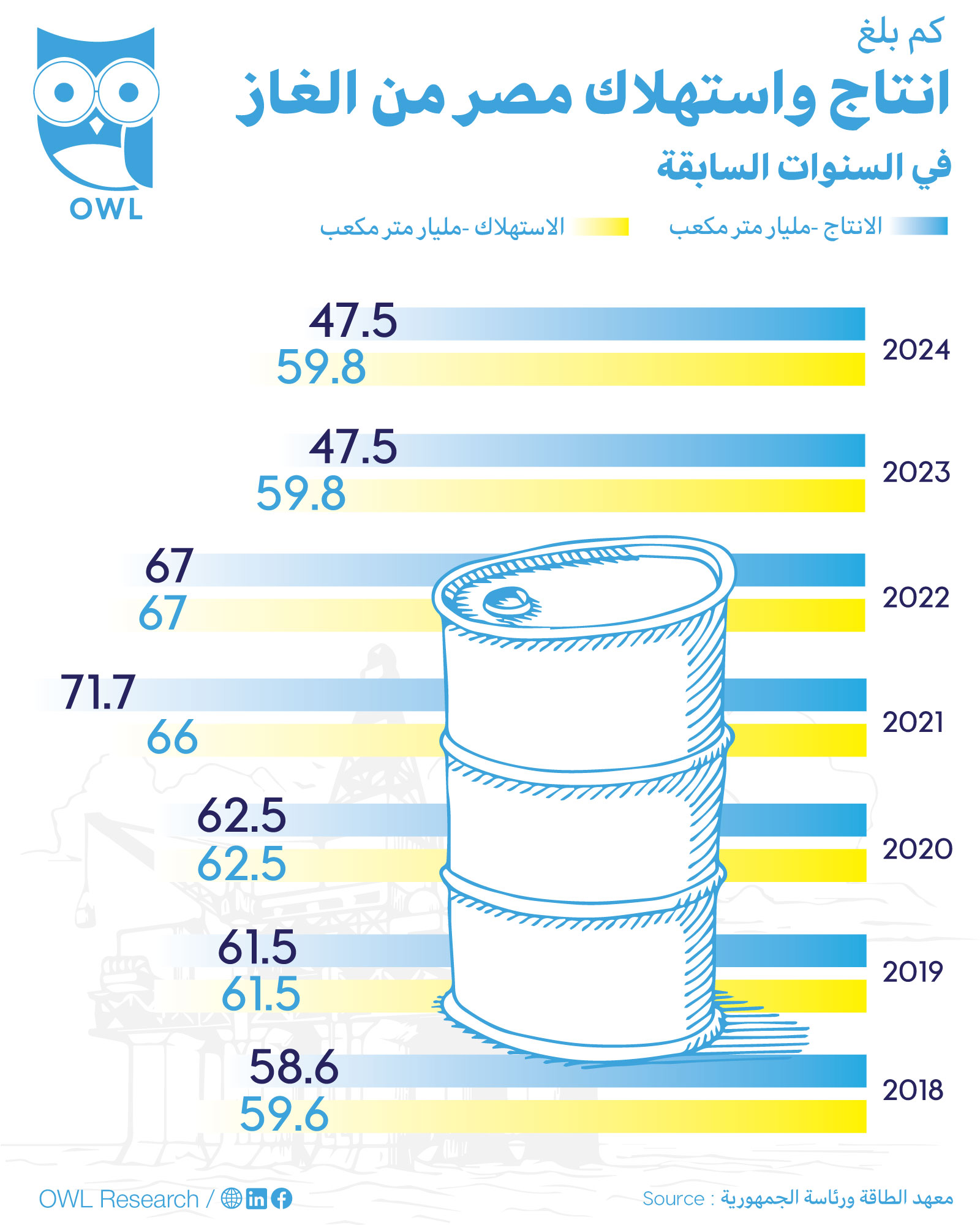
Natural gas plays a central role in Egypt’s energy sector, both as a key domestic fuel and as a source of export revenue. According to data from the Egyptian Energy Institute and Presidency reports, Egypt has witnessed significant fluctuations in its natural gas production and consumption between 2018 and 2024. These changes highlight the country’s efforts to balance local demand with its ambitions to remain a regional energy hub.
Egypt’s Natural Gas Production vs. Consumption (Billion Cubic Meters)
- 2018: Production 58.6 – Consumption 59.6
- 2019: Production 61.5 – Consumption 61.5
- 2020: Production 62.5 – Consumption 62.5
- 2021: Production 71.7 – Consumption 66
- 2022: Production 67 – Consumption 67
- 2023: Production 47.5 – Consumption 59.8
- 2024: Production 47.5 – Consumption 59.8
Key Insights
1. Years of Balance (2019–2020)
During 2019 and 2020, Egypt achieved a rare balance between production and consumption, with both at around 61–62 billion cubic meters (BCM). This stability reflected increased output from offshore gas fields such as Zohr.
2. Production Peak in 2021
Egypt’s production surged to 71.7 BCM in 2021, surpassing consumption by nearly 6 BCM. This marked Egypt’s strongest year as a net exporter, supporting its LNG shipments to Europe and Asia.
3. Decline in Production (2023–2024)
Production dropped sharply to 47.5 BCM, while consumption remained high at nearly 60 BCM. This deficit forced Egypt to rely on imports, straining its trade balance and highlighting the importance of new exploration and investments.
4. Domestic Demand Pressure
Egypt’s growing population and industrial needs continue to push consumption levels above production. The challenge is to secure sustainable energy supplies while meeting export commitments.
Future Outlook
- Exploration & Investment: Egypt is focusing on new offshore discoveries in the Mediterranean and Red Sea to restore output.
- Energy Diversification: Expanding renewable energy capacity (solar and wind) will help ease the burden on natural gas.
- Export Strategy: Despite short-term deficits, Egypt aims to maintain its role as an LNG hub for Europe, especially amid global demand shifts.
Conclusion
Between 2018 and 2024, Egypt’s natural gas journey has seen phases of balance, surplus, and deficit. While 2021 marked a high point in production, recent years show the urgency of new exploration and energy diversification. For policymakers and investors, Egypt’s natural gas sector remains both a challenge and an opportunity, central to the country’s economic and energy future.