Background
Since the escalation of Houthi attacks on shipping lanes in the Red Sea, global trade has been forced to find alternative routes to maintain the flow of goods. Israel, in particular, has been under direct pressure as Houthi forces declared Israeli-linked vessels as legitimate targets. To overcome this, Israel has leaned on a land corridor through Arab countries, creating a strategic bypass that keeps supply chains running.
The Land Route Explained
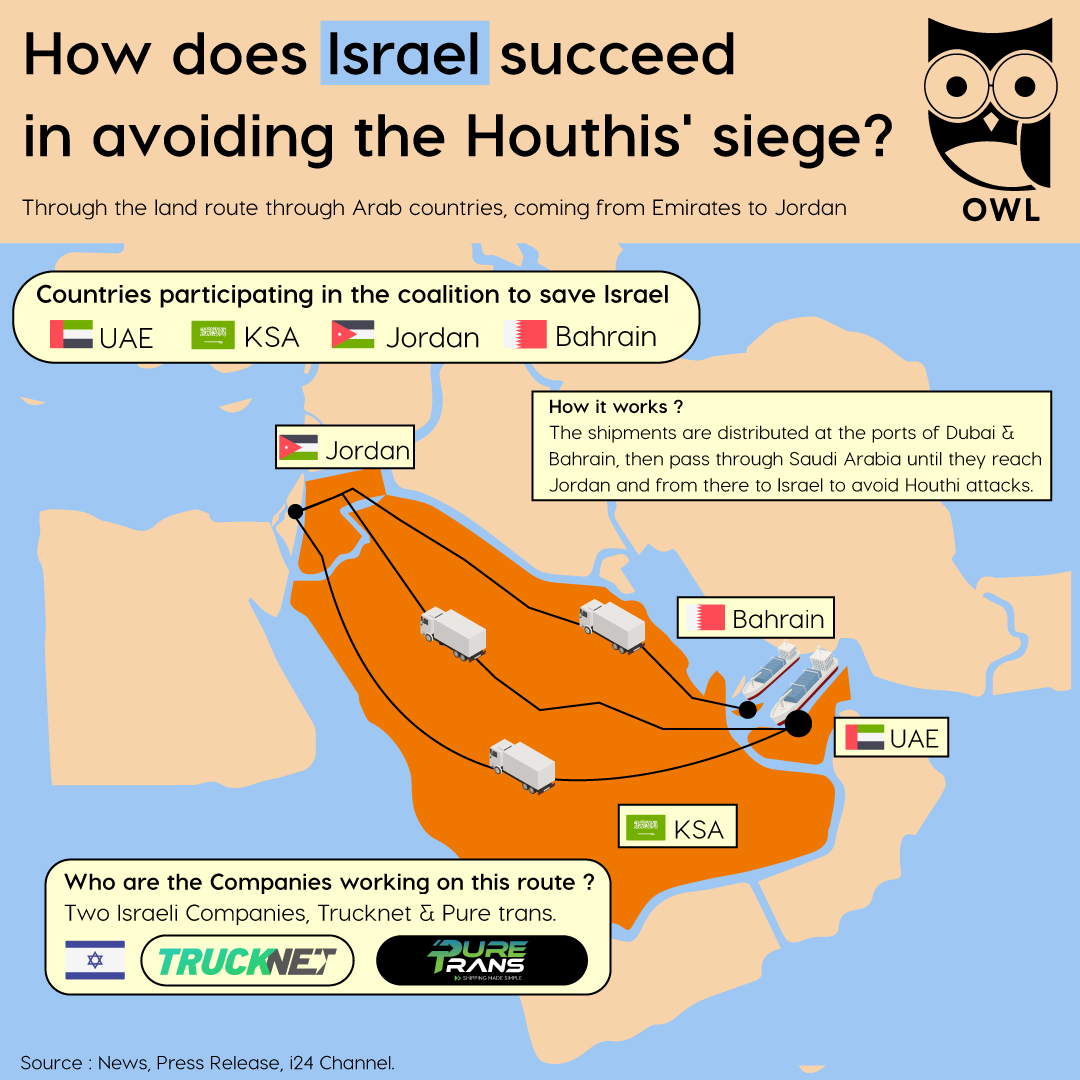
Instead of relying on ships passing through the Bab el-Mandeb Strait and the Red Sea, which are vulnerable to Houthi missile and drone attacks, Israel has shifted shipments through a land-based coalition route:
- UAE and Bahrain as Entry Points
- Goods are first received at the ports of Dubai (UAE) and Bahrain.
- These hubs act as distribution points for shipments bound for Israel.
- Transit Across Saudi Arabia
- From Bahrain and the UAE, cargo is loaded onto trucks and driven through Saudi Arabia, a critical transit corridor.
- Jordan as a Gateway
- Trucks continue through Jordan, where goods are then redirected northwards.
- Jordan functions as the last checkpoint before shipments reach Israel.
This route ensures that Israel avoids the vulnerable Red Sea shipping lanes entirely.
Countries Involved in the Coalition
The corridor depends on quiet cooperation from several Arab states, despite the political sensitivities:
- UAE 🇦🇪
- Bahrain 🇧🇭
- Saudi Arabia 🇸🇦
- Jordan 🇯🇴
This coalition, though not officially advertised as political support for Israel, plays a crucial logistical role in sustaining its economy during the siege.
Companies Operating the Route
According to reports, two Israeli logistics firms are central to coordinating this operation:
- Trucknet
- Pure Trans
They handle the overland distribution, ensuring smooth cross-border flows despite the complexities of customs and regional geopolitics.
Strategic Significance
- Economic Lifeline: The land corridor provides Israel with a reliable import channel for essential goods and industrial supplies.
- Geopolitical Message: The quiet cooperation of Arab states—some of whom do not formally recognize Israel—signals shifting regional dynamics where economic pragmatism sometimes overrides politics.
- Regional Risks: While effective, this route depends heavily on political stability in Saudi Arabia and Jordan. Any shifts in alliances or public backlash could disrupt it.
Conclusion
Israel’s ability to bypass Houthi threats in the Red Sea demonstrates the flexibility of modern trade routes and the importance of regional partnerships. By leveraging the logistical infrastructure of the UAE, Bahrain, Saudi Arabia, and Jordan, Israel has secured a critical economic corridor. This strategy highlights not just resilience under siege but also the complex web of cooperation—often behind the scenes—that keeps Middle Eastern supply chains alive.