On Mother’s Day, conversations often celebrate emotional contributions—care, love, and support. However, what remains significantly undervalued is the economic contribution of women, particularly in markets like Egypt where a large portion of this value remains invisible in traditional economic metrics.
At OWL Research, we believe that understanding people is the foundation of better business and policy decisions. And when it comes to women in Egypt, the data tells a powerful, often overlooked story.
Women in the Formal Economy: A Limited but Impactful Presence
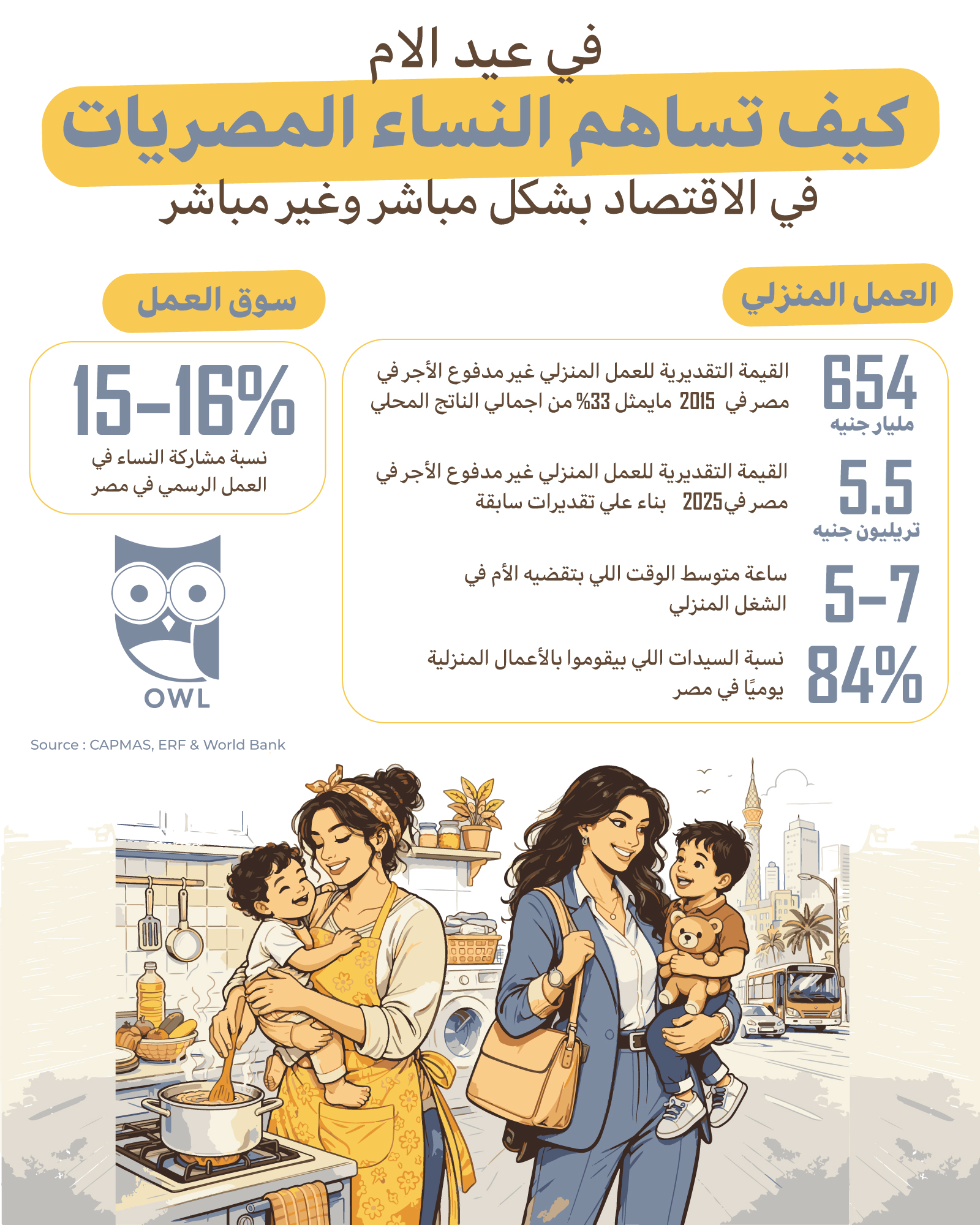
Women’s participation in Egypt’s formal labor market remains relatively low, with estimates ranging between 15–16%.
While this figure may appear modest, it masks a deeper reality:
- Women contribute significantly in education, healthcare, and service sectors
- Their participation is often constrained by cultural norms, childcare responsibilities, and structural barriers
This indicates that the formal economy only captures a fraction of women’s true economic value.
The Invisible Economy: Unpaid Domestic Work
A much larger contribution lies in unpaid domestic labor, which includes:
- Childcare
- Cooking and cleaning
- Household management
- Emotional and social support
Key Insight:
- Around 84% of women in Egypt perform domestic work daily
- Women spend 5–7 hours per day on unpaid household tasks
This is not just “family support”—it is economic activity that sustains society.
Assigning Value: The Hidden Trillions
When economists attempt to quantify unpaid labor, the results are striking:
- In 2015, the estimated value of unpaid domestic work in Egypt reached 654 billion EGP, equivalent to roughly 33% of GDP
- Projections suggest this could reach 5.5 trillion EGP by 2025
What does this mean?
If unpaid work were monetized:
- It would represent one of the largest economic sectors in the country
- It would reshape how we measure productivity and growth
The Real Insight: Women Are Economic Infrastructure
From an insights perspective, women—especially mothers—are not just contributors. They are:
1. Enablers of the Workforce
By managing households, women enable other family members to participate in the economy.
2. Human Capital Builders
Through childcare and education, they directly shape future generations.
3. Stability Drivers
Their unpaid work reduces societal costs and supports economic resilience.
Implications for Brands, Policy Makers, and Businesses
Understanding this hidden value opens new opportunities:
For Brands:
- Design products and services that save time and effort
- Communicate with empathy toward the real daily pressures women face
For Policy Makers:
- Consider integrating unpaid work into economic indicators
- Invest in childcare infrastructure and flexible work policies
For Businesses:
- Recognize women not only as consumers but as system-level contributors
- Build solutions that support work-life integration
Conclusion
Women in Egypt are not just part of the economy—they are a core engine driving it, both visibly and invisibly.
As we celebrate Mother’s Day, it’s time to shift the narrative:
From appreciation… to recognition
From recognition… to measurement
From measurement… to action
At OWL Research, we see people not just as consumers—but as the true drivers of value.