Egypt has one of the largest healthcare workforces in the region, yet the country continues to face a persistent challenge: the migration of doctors seeking better professional and financial opportunities abroad.
The issue is not simply about salaries. It reflects a wider combination of working conditions, career development, training opportunities and the overall economics of the medical profession.
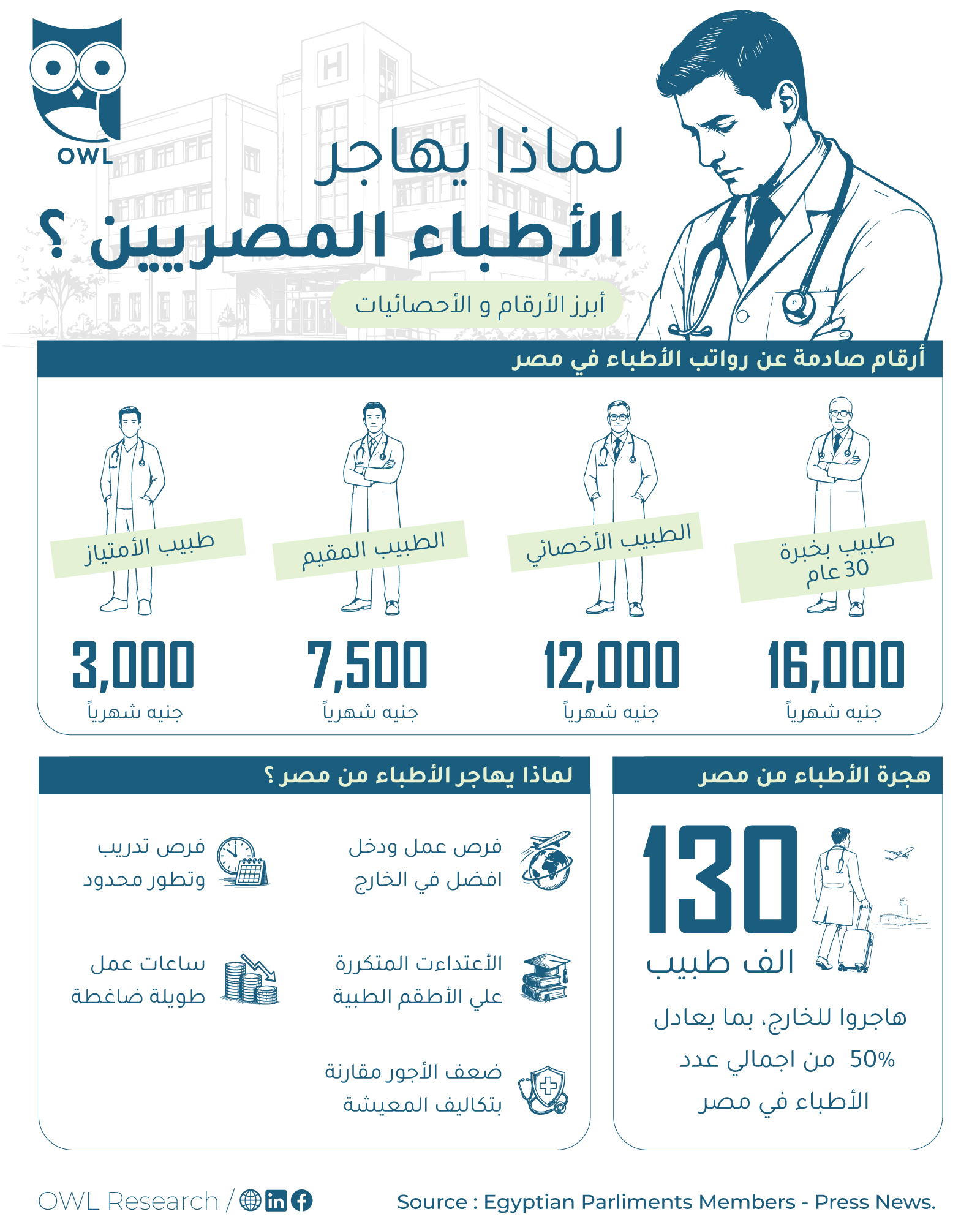
According to the figures presented in our analysis, around 130,000 Egyptian doctors have migrated abroad, equivalent to approximately 50% of the total number of doctors in Egypt.
A Significant Pay Gap
One of the clearest factors behind doctors’ migration is the difference between domestic earnings and international opportunities.
The infographic highlights a significant variation in monthly salaries depending on experience and professional level.
A doctor with around 30 years of experience earns approximately EGP 16,000 per month, while a specialist earns around EGP 12,000.
A resident doctor earns approximately EGP 7,500, while an excellent doctor is shown at around EGP 3,000 per month.
These figures illustrate the financial pressures facing medical professionals, particularly when compared with the potential earnings available in international healthcare markets.
Why Are Doctors Looking Abroad?
Salary is only one part of the story.
Doctors considering migration may also be influenced by several professional factors, including:
- Better employment and income opportunities abroad
- More structured training and career development
- Repeated pressure on medical teams
- Long and demanding working hours
- Limited professional development opportunities
- A wider gap between medical salaries and living costs
Together, these factors can make international opportunities increasingly attractive to qualified healthcare professionals.
The Cost of Losing Medical Talent
The migration of doctors creates challenges that extend beyond the individual.
Healthcare systems invest significant resources in medical education, clinical training and professional development before doctors enter the workforce.
When experienced physicians leave, the country can lose not only healthcare capacity, but also valuable expertise that takes years to develop.
The impact can be particularly significant in specialised fields where experienced professionals are already limited.
A Healthcare Workforce Challenge
Doctor migration is therefore not simply a labour-market issue. It is also a question of healthcare capacity and human capital.
A country can continue producing medical graduates while still experiencing shortages if the number of professionals leaving the system exceeds the capacity to retain and replace them.
This creates a difficult cycle: fewer experienced doctors can place additional pressure on those who remain, potentially contributing to heavier workloads and making overseas opportunities even more attractive.
The Bigger Picture
The Egyptian case reflects a broader global trend in healthcare.
Medical professionals are increasingly mobile, and countries compete not only for patients and healthcare investment, but also for highly skilled medical talent.
For Egypt, improving doctor retention requires looking beyond headline salaries and considering the wider professional proposition: income, working conditions, training, career progression and quality of life.
OWL Research Perspective
At OWL Research, we look at workforce trends through the lens of economics, human capital and market dynamics.
The migration of Egyptian doctors highlights a broader challenge facing many emerging markets: retaining highly skilled professionals in sectors where human capital takes years to develop.
When talent leaves, the cost is not measured only in lost employees. It is measured in the expertise, investment and capacity that leave with them.