Wheat is more than a staple food. For many countries, it is also a critical part of the global food-security equation.
Russia and Ukraine have long played a major role in international wheat trade, particularly across the Middle East, Africa and parts of Asia. Their geographic proximity to major importing markets, combined with competitive production and shipping economics, has made Black Sea wheat an important source for many countries.
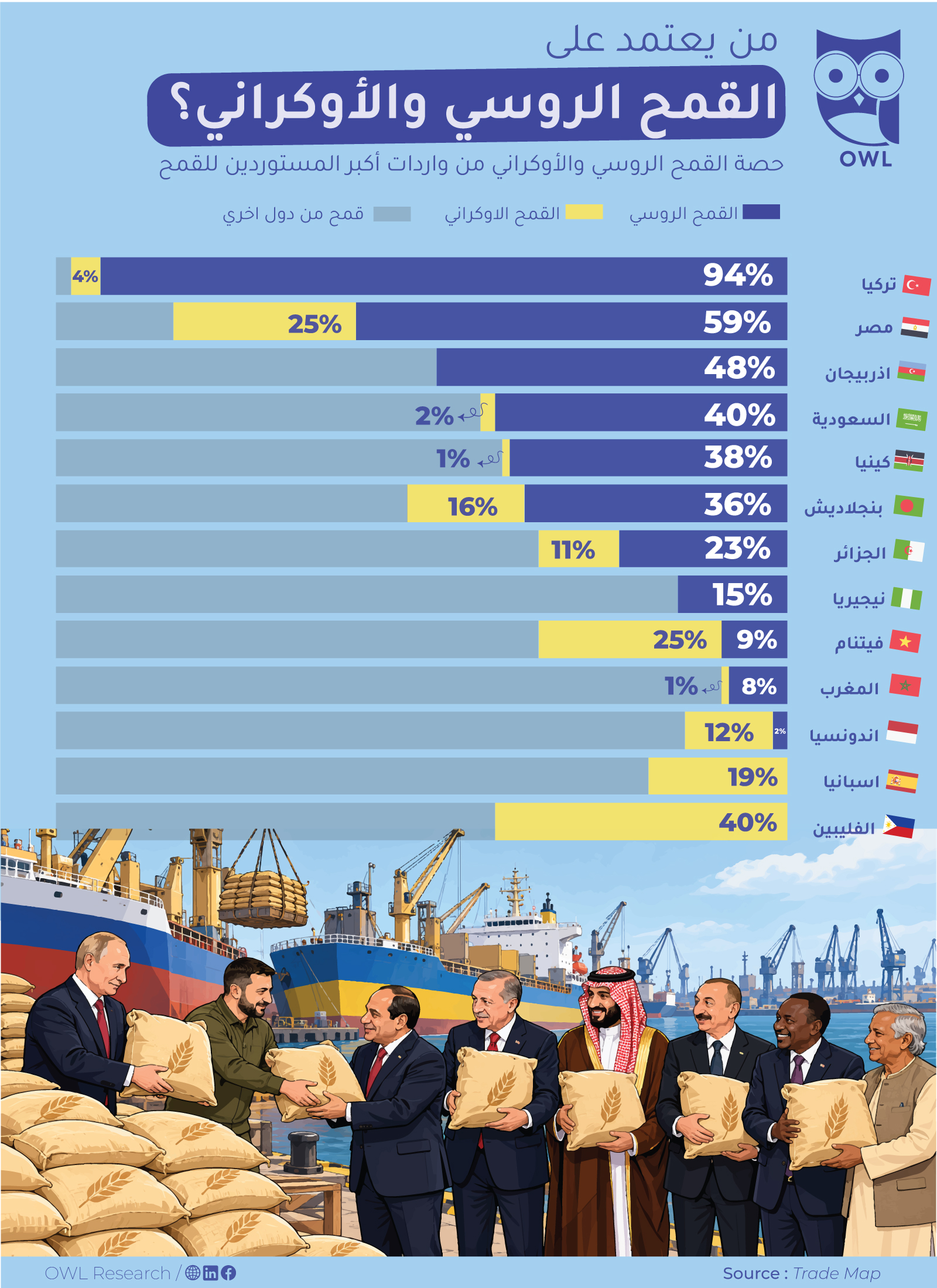
The data presented by OWL Research, based on Trade Map, highlights the degree to which several major wheat-importing markets depend on Russian and Ukrainian supplies.
Russia remains a major supplier
Russia has established a particularly strong position in several wheat-importing markets. Countries such as Turkey, Egypt, Azerbaijan, Saudi Arabia and Kenya have significant exposure to Russian wheat.
The relationship is especially important for Egypt. The country has historically relied heavily on Black Sea wheat because of its competitive pricing and relatively short shipping distance to Egyptian ports. Recent USDA data also shows that Russia and Ukraine remain the two largest sources of wheat imports into Egypt. From July 2025 to January 2026, Egypt imported around 8.8 million tonnes of wheat, including approximately 5.28 million tonnes from Russia and 2.16 million tonnes from Ukraine. USDA Apps
Ukraine plays a different but equally important role
Ukraine has also been a major supplier to global wheat markets, with particularly strong relationships across North Africa, the Middle East and Asia.
Egypt is one of the most important destinations for Ukrainian wheat. According to recent trade data, Egypt imported approximately 1.9 million tonnes of Ukrainian wheat between July 2024 and May 2025, with total shipments for the marketing year expected to exceed 2 million tonnes. odessa-journal.com
The importance of Ukrainian wheat is also visible across Africa. ITC Trade Map data cited by the Kyiv School of Economics shows that Ukrainian wheat accounted for 25% of Egypt’s wheat imports in 2021, while the share reached 31% in Tunisia, 29% in Morocco and 45% in Ethiopia. Kyiv School of Economics
Why does this matter?
High concentration in a small number of supplier countries can create both economic and food-security risks.
When wheat supplies from Russia or Ukraine are disrupted, importing countries may need to turn to alternative suppliers such as the European Union, Canada, Australia or the United States. However, changing suppliers can involve higher freight costs, longer shipping distances and different price dynamics.
Egypt provides a clear example of this exposure. Research on Egypt’s wheat supply has found that Russia and Ukraine together accounted for a very large share of the country’s wheat imports, making developments in the Black Sea particularly relevant to Egyptian food security. Frontiers
The bigger picture
The map of global wheat trade is therefore not simply about who exports the most. It is also about who depends on whom.
For importing countries, diversification of suppliers can reduce exposure to disruptions in a single market or trade corridor. At the same time, maintaining access to competitively priced Black Sea wheat remains economically important for countries with large import requirements.
For businesses, investors and policymakers, monitoring Russian and Ukrainian wheat flows can therefore provide an early indication of potential changes in food prices, import costs, inflationary pressure and food-security risks.
OWL Research will continue to track the trade flows, market developments and economic indicators shaping Egypt and the wider MENA region.