Immigration enforcement has been a major feature of U.S. policy for decades, with the scale and composition of removals changing significantly from one presidential administration to another.
Data from the U.S. Department of Homeland Security (DHS), Immigration and Customs Enforcement (ICE), and the Office of Homeland Security Statistics (OHSS) provide a long-term view of immigration enforcement actions, including removals, returns and expulsions. ohss.dhs.gov
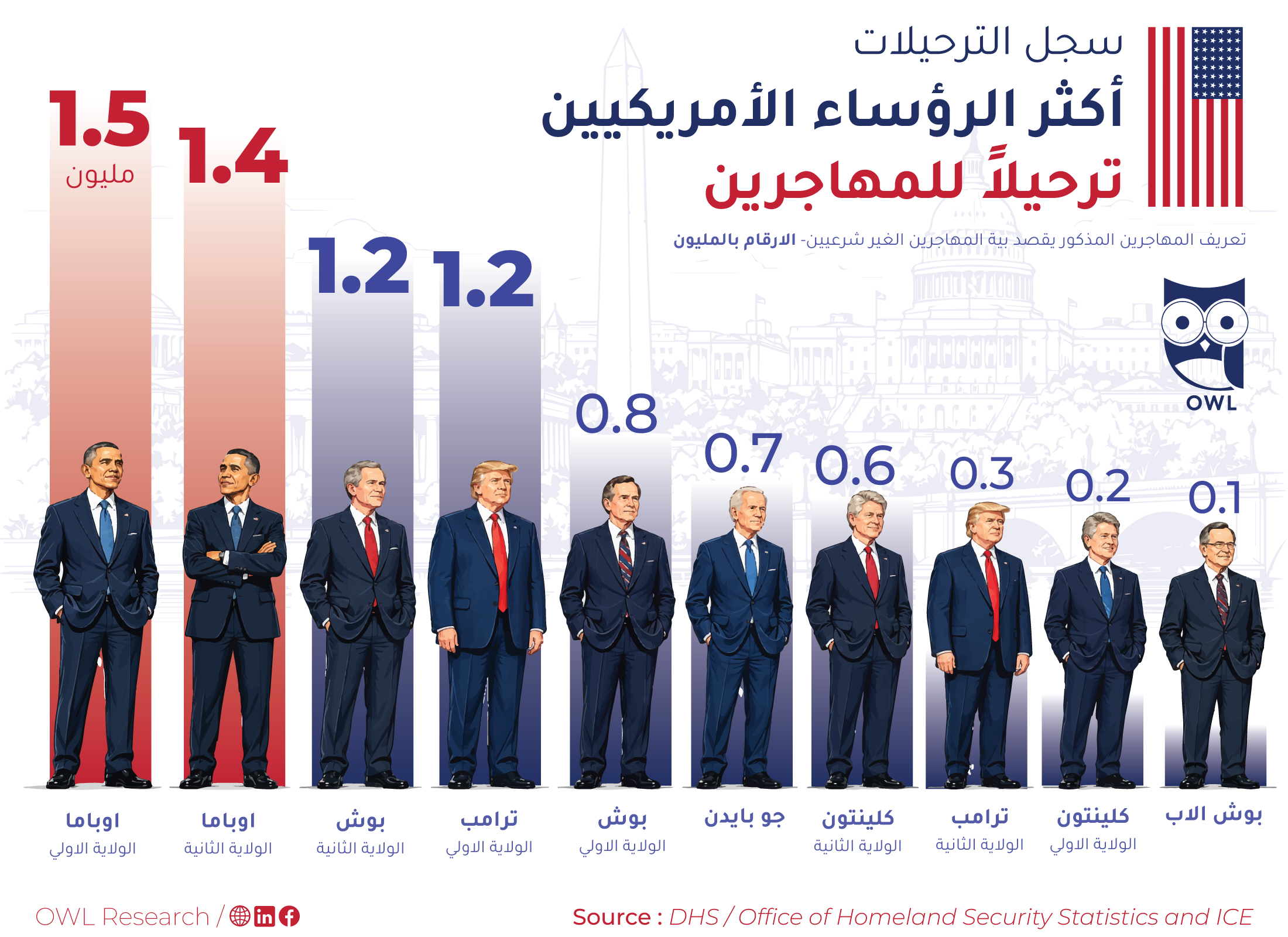
A long history of immigration enforcement
The number of people removed from the United States has varied considerably across administrations.
During the Obama administration, formal removals reached historically high levels. DHS data show that annual removals peaked at more than 400,000 in the early 2010s, before declining significantly toward the end of the administration. Academic analysis of DHS data records 401,501 removals in 2009, rising to 407,821 in 2012, followed by a decline to 76,124 in 2016. Sage Journals
The Trump administration’s first term also saw substantial immigration enforcement activity. Contemporary reporting based on DHS data put the number of deportations during the four-year administration at approximately 1.5 million, although comparisons depend heavily on whether removals, returns and other forms of repatriation are included. EL PAÍS English
Under President Joe Biden, immigration enforcement took place against a very different border environment. DHS reported that FY2024 recorded more than 685,000 removals and returns, the highest annual total since 2010. Department of Homeland Security
Why the numbers can be misleading
A simple ranking of presidents by “deportations” can obscure important differences in how the U.S. government defines and records immigration enforcement.
According to DHS, a removal refers to the repatriation of an inadmissible or deportable noncitizen who is subject to a final order of removal. A return refers to a confirmed departure where the individual was not subject to a removal order. Department of Homeland Security
There is also a third category: expulsions under Title 42, the public-health authority used between March 2020 and May 2023. DHS recorded more than 3.7 million Title 42 expulsions during that period, meaning that these cases should not simply be added to conventional removal figures without explaining the difference. Department of Homeland Security
This distinction is particularly important when comparing the Trump and Biden administrations because Title 42 was introduced during Trump’s first term but remained in effect for most of Biden’s first two years.
The Biden years and a changing enforcement landscape
Immigration enforcement during the Biden administration combined removals and returns with a large number of border expulsions during the continuation of Title 42.
By FY2024, DHS reported more than 685,000 removals and returns, including more than 43,000 removals of people classified as aggravated felons. Department of Homeland Security
The composition of enforcement also matters. Border encounters, expedited removals and interior enforcement do not represent the same type of immigration action, even when they are sometimes grouped together in public discussions.
A new enforcement phase under Trump
Donald Trump’s return to the presidency in January 2025 brought a renewed emphasis on immigration enforcement and deportation.
DHS has reported expanded cooperation between federal, state and local law-enforcement agencies through the 287(g) program, which allows participating state and local officers to perform certain immigration-enforcement functions under federal supervision. By September 2025, DHS reported more than 1,000 287(g) agreements across 40 states. Department of Homeland Security
DHS also announced that its enforcement operations had resulted in more than 1.6 million people leaving the U.S. population during the first 200 days of the administration, including people who voluntarily departed. However, this figure is broader than conventional deportation or removal statistics and therefore should not be directly compared with historical ICE removal totals. Department of Homeland Security
What the numbers tell us
The historical record shows that immigration enforcement is not a single, consistent measure.
Changes in:
- Border crossings
- Immigration court decisions
- Removal orders
- Interior enforcement
- International cooperation
- Detention capacity
- Title 42 policies
- Voluntary departures
can all affect the number recorded by federal agencies.
For this reason, understanding the definition behind the number is just as important as the number itself.
The bigger picture
Across successive U.S. administrations, immigration enforcement has remained a significant policy and operational issue, but the tools, priorities and circumstances surrounding enforcement have changed.
For researchers, businesses and policymakers, tracking these changes provides insight into broader developments in labor markets, demographics, border policy, government spending and the U.S. immigration system.