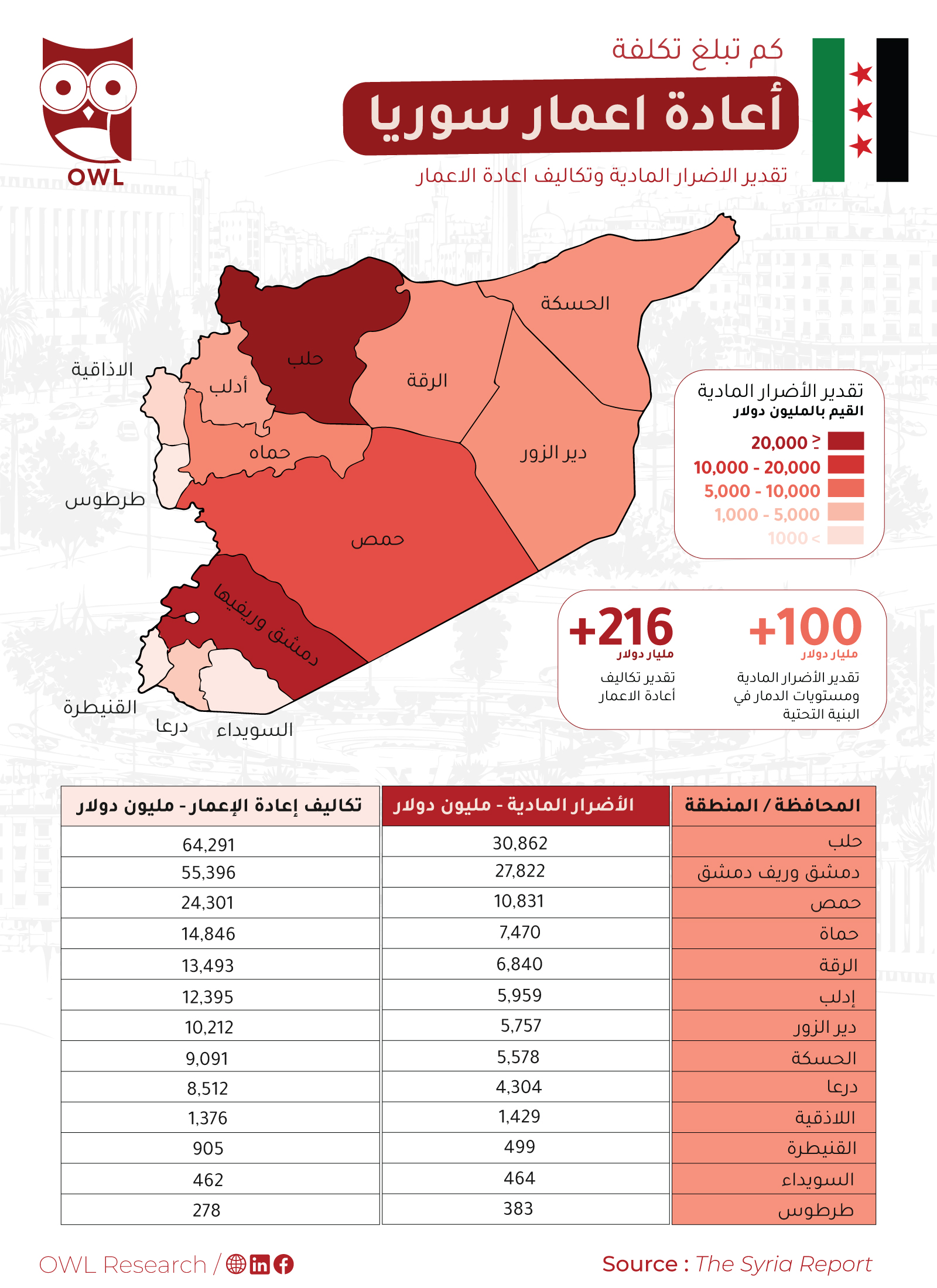
Physical damage across Syria is estimated at more than $100 billion, while reconstruction costs could exceed $216 billion, highlighting the scale of the country’s recovery challenge.
More than a decade of conflict has left Syria facing extensive damage to its housing, infrastructure, industrial facilities, and essential public services. Rebuilding the country will require substantial financial resources, long-term investment, and coordinated efforts across multiple economic sectors.
According to estimates presented in The Syria Report and summarized in the OWL Research infographic, the total cost of reconstruction is estimated at approximately $216 billion, while physical damage is estimated at more than $100 billion.
These figures illustrate the scale of the challenge facing Syria as it seeks to restore essential infrastructure, revive economic activity, and create the conditions for sustainable recovery.
The Scale of Syria’s Reconstruction Challenge
The estimated reconstruction bill of $216 billion highlights the financial requirements associated with rebuilding damaged assets and restoring essential services.
The cost of reconstruction is higher than the estimated value of physical damage because rebuilding involves more than repairing or replacing damaged structures. Depending on the methodology used, estimates may also account for construction costs, infrastructure restoration, replacement requirements, and the resources needed to return damaged assets to operational use.
The distinction between physical damage and reconstruction costs is therefore important when assessing Syria’s recovery needs.
Physical damage estimates measure the value of assets affected by conflict, while reconstruction estimates seek to quantify the cost of restoring or rebuilding them.
Which Syrian Governorates Face the Highest Reconstruction Costs?
The distribution of estimated damage and reconstruction costs varies significantly across Syria’s governorates.
According to the figures presented in the infographic, Aleppo records the highest estimated reconstruction cost, at approximately $64.3 billion, followed by Damascus and Rural Damascus at $55.4 billion.
Homs ranks third, with estimated reconstruction costs of $24.3 billion, followed by Hama at $14.8 billion and Raqqa at $13.5 billion.
Idlib and Deir ez-Zor also face substantial reconstruction requirements, with estimated costs of $12.4 billion and $10.2 billion, respectively.
The figures suggest that reconstruction needs are concentrated in a number of major urban and economically significant areas.
Estimated Reconstruction Costs by Governorate
| Governorate / Region | Estimated Physical Damage | Estimated Reconstruction Cost |
|---|---|---|
| Aleppo | $30.862B | $64.291B |
| Damascus and Rural Damascus | $27.822B | $55.396B |
| Homs | $10.831B | $24.301B |
| Hama | $7.470B | $14.846B |
| Raqqa | $6.840B | $13.493B |
| Idlib | $5.959B | $12.395B |
| Deir ez-Zor | $5.757B | $10.212B |
| Hasakah | $5.578B | $9.091B |
| Daraa | $4.304B | $8.512B |
| Latakia | $1.429B | $1.376B |
| Quneitra | $0.499B | $0.905B |
| As-Suwayda | $0.464B | $0.462B |
| Tartus | $0.383B | $0.278B |
Figures are presented in US dollars and reproduce the estimates shown in the OWL Research infographic. The underlying report’s methodology, geographic definitions, and reference date should be checked before publication.
Aleppo and Damascus Lead the Reconstruction Agenda
Aleppo and Damascus, including Rural Damascus, account for the largest estimated reconstruction requirements in the infographic.
Their combined estimated reconstruction costs exceed $119 billion, representing a substantial share of the total presented in the regional breakdown.
The scale of these requirements reflects the importance of restoring housing, transport links, utilities, commercial facilities, and other urban assets.
Reconstruction in these areas could also have wider economic implications because major urban centers support employment, trade, manufacturing, and service-sector activity.
However, investment requirements will vary by location and sector, depending on the condition of existing infrastructure, the availability of essential services, and the feasibility of restoring damaged assets.
What Do the Estimates Mean for Syria’s Economy?
Reconstruction is not simply a construction challenge. It is also a long-term economic recovery process involving public services, private investment, employment, and the restoration of productive capacity.
Several priorities are likely to shape the process.
1. Infrastructure and essential services
Restoring electricity, water networks, roads, healthcare facilities, and other essential infrastructure will be critical to enabling households and businesses to resume normal activity.
2. Housing and urban recovery
Repairing and rebuilding residential properties will be important for communities returning to damaged areas and for restoring local economic activity.
3. Industrial and commercial recovery
Rehabilitating factories, commercial buildings, logistics facilities, and other productive assets could help restore employment and support domestic supply chains.
4. Financing and investment mobilization
The scale of the estimated reconstruction bill means that recovery will require a combination of financing mechanisms, private-sector participation, institutional capacity, and carefully prioritized investment.
The availability of capital alone will not determine the pace of recovery. Security conditions, regulatory frameworks, infrastructure readiness, and the ability to execute projects will also influence investment decisions.
Where Could Investment Opportunities Emerge?
The reconstruction process could generate demand across several sectors, including construction materials, engineering services, infrastructure development, energy, transport, housing, and utilities.
Companies operating in these sectors may find opportunities to participate in rehabilitation and development projects as conditions permit.
Nevertheless, the size of the estimated reconstruction requirement should not be interpreted as an immediate addressable market for private investors.
Actual commercial opportunities will depend on project approvals, financing availability, procurement frameworks, regulatory requirements, and the feasibility of operating in specific locations.
For businesses assessing Syria, detailed market research and project-level due diligence will be essential to distinguish long-term reconstruction needs from projects that are commercially viable in the near term.
The Outlook: A Long-Term Recovery Process
Syria’s estimated reconstruction costs highlight the magnitude of the work required to restore damaged infrastructure, housing, and productive assets.
With Aleppo and Damascus representing the largest reconstruction requirements in the infographic, regional priorities are likely to play an important role in determining how resources are allocated.
However, sustainable recovery will depend on more than rebuilding physical structures. It will also require restoring essential services, supporting economic activity, mobilizing financing, and establishing conditions that allow businesses and communities to recover.
For policymakers, investors, and businesses, the central challenge is translating Syria’s extensive reconstruction needs into a realistic, phased, and financially sustainable recovery process.