Nearly 1.75 million Syrians returned during the period covered by the data, with Damascus and Rural Damascus, Aleppo, and Idlib accounting for substantial shares of reported returnees.
The return of Syrian refugees and displaced populations has become an important indicator of the country’s evolving humanitarian and economic landscape. As communities begin returning to their places of origin, the scale and geographical distribution of these movements offer insights into changing population patterns and the potential demands on local infrastructure and public services.
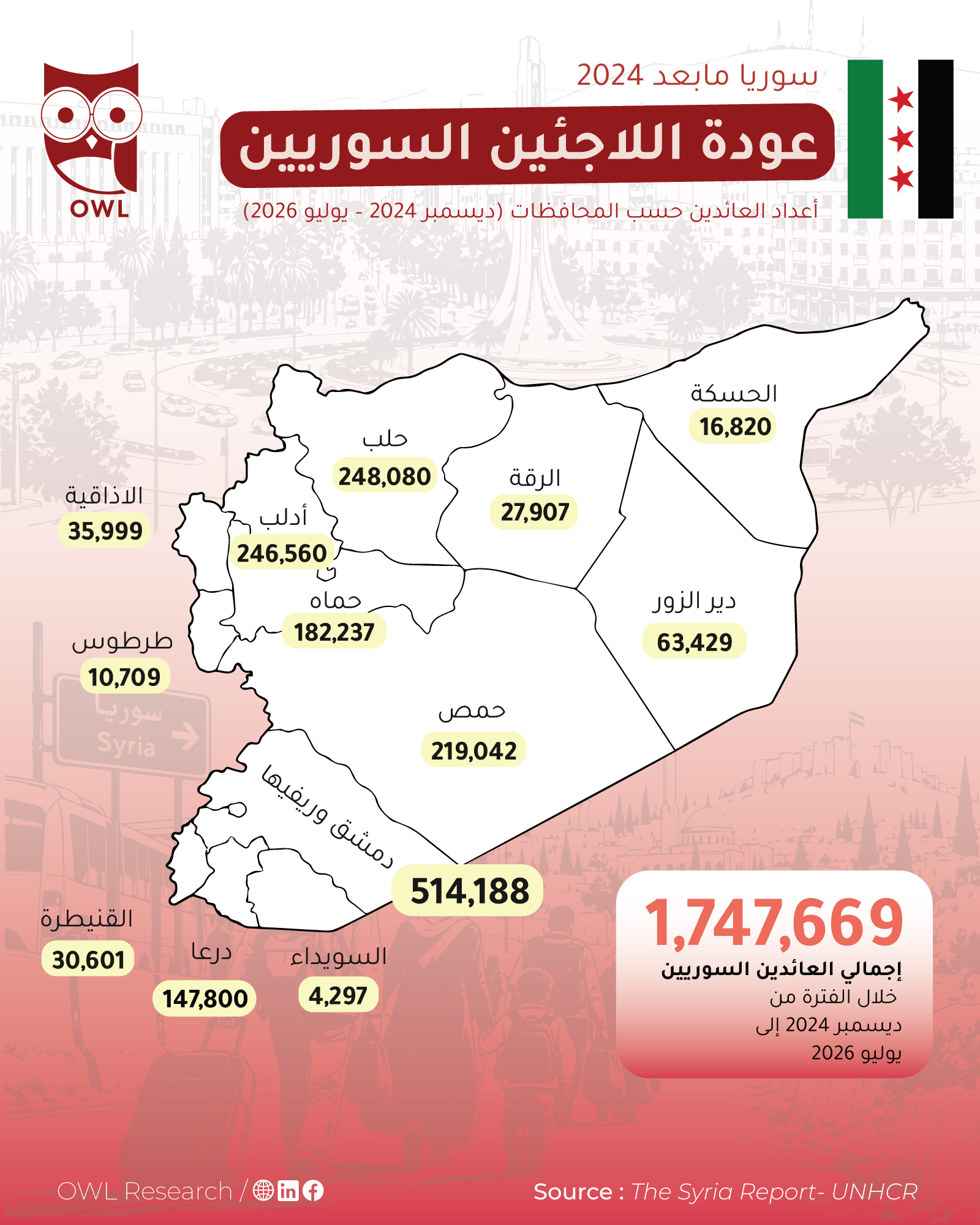
According to figures attributed to The Syria Report and the United Nations High Commissioner for Refugees (UNHCR), approximately 1,747,669 Syrians returned between December 2024 and July 2026.
The figures presented in the OWL Research infographic highlight considerable differences between governorates, with some receiving substantially more returnees than others.
Where Are Syrian Returnees Going?
The geographical distribution of reported returns is uneven, with several governorates accounting for particularly large numbers.
Damascus and Rural Damascus recorded approximately 514,188 returnees, making them the largest destination in the infographic. Aleppo followed with 248,080 returnees, while Idlib recorded 246,560.
Homs received approximately 219,042 returnees, followed by Hama with 182,237 and Daraa with 147,800.
Other governorates recorded smaller totals, including Deir ez-Zor at 63,429, Latakia at 35,999, Raqqa at 27,907, and Hasakah at 16,820.
Quneitra recorded approximately 30,601 returnees, while Tartus recorded 10,709 and As-Suwayda 4,297.
These differences highlight the importance of examining return movements at the governorate level rather than relying exclusively on a national total.
Syrian Returns by Governorate
| Governorate / Region | Reported Returnees |
|---|---|
| Damascus and Rural Damascus | 514,188 |
| Aleppo | 248,080 |
| Idlib | 246,560 |
| Homs | 219,042 |
| Hama | 182,237 |
| Daraa | 147,800 |
| Deir ez-Zor | 63,429 |
| Latakia | 35,999 |
| Quneitra | 30,601 |
| Raqqa | 27,907 |
| Hasakah | 16,820 |
| Tartus | 10,709 |
| As-Suwayda | 4,297 |
| Total shown in infographic | 1,747,669 |
Source attribution and figures are reproduced from the OWL Research infographic. The original reporting definitions should be checked to determine which categories of returnees are included.
Damascus, Aleppo, and Idlib Lead Reported Returns
Damascus and Rural Damascus account for the largest reported number of returnees, reflecting the importance of the capital region and its surrounding communities in Syria’s population movements.
Aleppo and Idlib also recorded substantial numbers. These governorates have experienced extensive displacement during the conflict, making return movements particularly significant for local housing, infrastructure, livelihoods, and access to essential services.
Homs and Hama similarly represent important areas for monitoring the relationship between population returns and local recovery.
However, return figures alone do not establish whether returnees have been able to resume permanent residence or rebuild their livelihoods. Conditions can differ significantly between communities, depending on housing availability, infrastructure, security, employment, and access to public services.
What Do Return Movements Mean for Syria’s Recovery?
The return of displaced populations can have important implications for Syria’s humanitarian response and economic recovery.
1. Increasing demand for housing
Returning households may require access to safe housing, repairs to damaged properties, and basic household infrastructure. In areas with extensive destruction, housing availability can become a significant constraint.
2. Pressure on essential services
Electricity, water, sanitation, healthcare, and education systems may face increased demand as populations return to their communities.
3. Rebuilding local economic activity
Population returns can support the recovery of local markets and services as households resume economic activity. However, sustainable recovery depends on employment opportunities, functioning infrastructure, and access to essential goods.
4. Greater need for targeted regional planning
The uneven distribution of returnees means that recovery priorities may differ substantially between governorates. Local population data can help humanitarian organizations, public authorities, and development partners identify areas where additional support may be required.
Why the Conditions of Return Matter
The number of people returning is an important indicator, but it should not be interpreted as a complete measure of recovery.
A return movement does not necessarily mean that a household has achieved a durable solution to displacement. Some families may face damaged homes, limited employment opportunities, disrupted services, or continued uncertainty about their long-term prospects.
For this reason, return statistics should be assessed alongside information on housing conditions, access to services, livelihoods, safety, and the sustainability of return.
Understanding these factors is essential for evaluating whether population movements are translating into lasting improvements in living conditions.
The Outlook: Monitoring Returns Alongside Recovery Indicators
The reported 1.75 million returns between December 2024 and July 2026 highlight the scale of population movements during the period covered by the infographic.
The concentration of returnees in Damascus and Rural Damascus, Aleppo, Idlib, Homs, and Hama underscores the importance of regional analysis when assessing Syria’s evolving humanitarian and economic needs.
For policymakers, humanitarian organizations, and development partners, the next priority is to understand not only where people are returning, but also whether communities have the housing, services, and economic opportunities required to support them.
The key measure of progress will be whether returns translate into safe, sustainable living conditions and a meaningful recovery in the communities people are returning to.