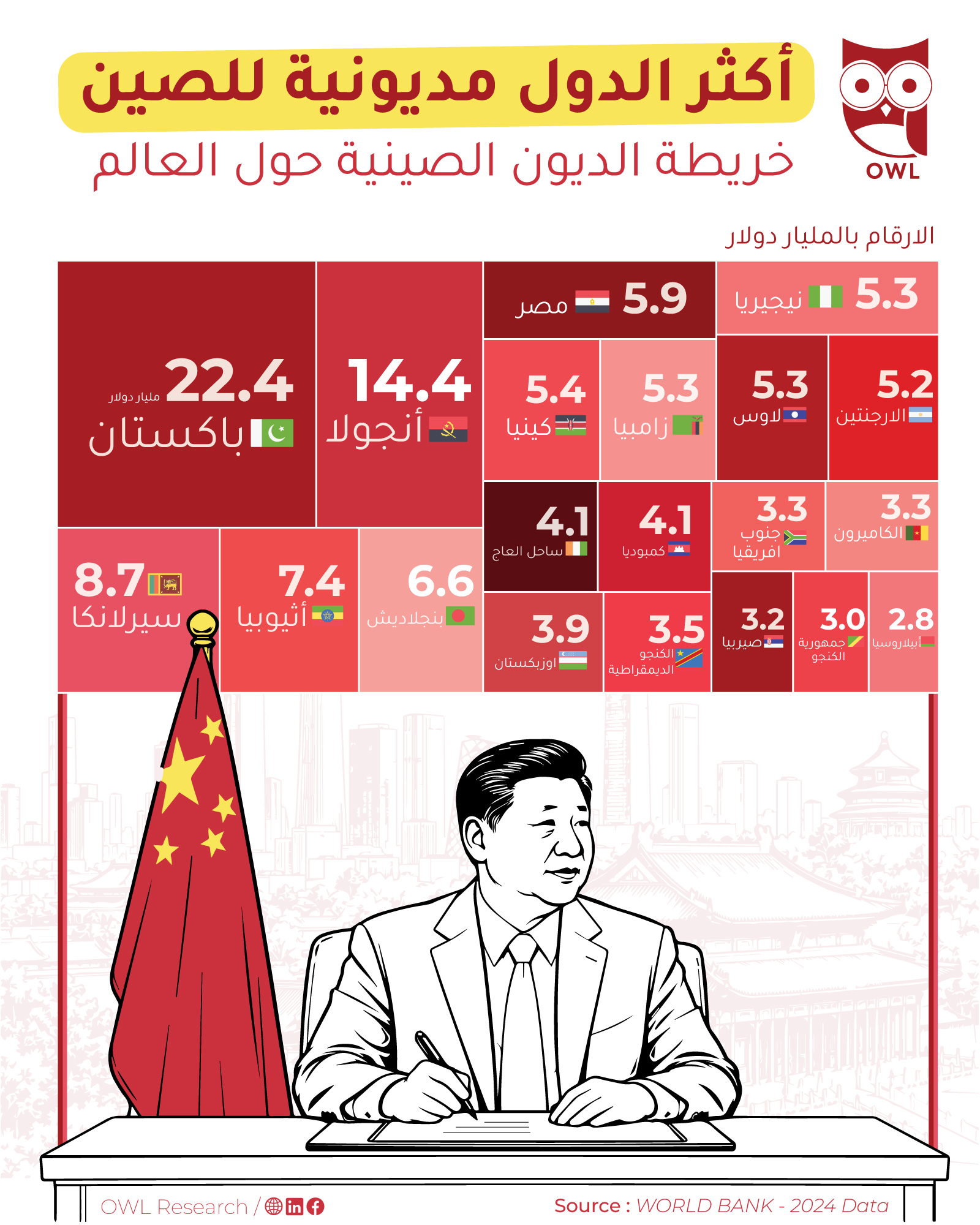
Pakistan tops the ranking with $22.4 billion in reported debt to China, followed by Angola at $14.4 billion, highlighting the scale of China’s international lending relationships across developing economies.
China has become a major source of international financing, supporting infrastructure development, energy projects, transportation networks, and other large-scale investments across emerging markets.
Its lending relationships span Asia, Africa, and Latin America, creating a diverse portfolio of international borrowers with varying levels of exposure to Chinese financing.
According to the figures presented in OWL Research’s infographic, based on World Bank 2024 data, Pakistan recorded the highest reported debt to China among the countries featured, at approximately $22.4 billion. Angola followed with $14.4 billion, while Sri Lanka recorded $8.7 billion.
The figures highlight the importance of understanding not only the size of bilateral debt, but also how countries manage repayment obligations, financing costs, and the economic returns generated by borrowed funds.
Pakistan Leads the Ranking of Countries Owing China
Pakistan ranks first in the infographic, with reported debt to China of approximately $22.4 billion.
Chinese financing has played an important role in Pakistan’s infrastructure and energy development, including projects associated with the China-Pakistan Economic Corridor.
While external financing can support infrastructure expansion and economic development, the sustainability of repayment depends on several factors, including project performance, foreign exchange availability, economic growth, and the structure of loan agreements.
Pakistan’s position highlights the importance of examining external debt alongside broader economic indicators rather than treating the outstanding amount as an isolated measure of financial risk.
Angola Ranks Second, Reflecting China’s Role in African Financing
Angola ranks second, with reported debt to China of approximately $14.4 billion.
Chinese financing has been significant in Angola’s infrastructure development and economic relationship with China, particularly in sectors connected to energy, transportation, and public investment.
For resource-producing economies, the relationship between debt repayment and commodity export revenues can be especially important. Fluctuations in oil prices, export receipts, and foreign currency availability can affect the capacity to service external obligations.
Angola’s position illustrates how Chinese lending relationships can be closely linked to infrastructure development, commodity trade, and national financing strategies.
Sri Lanka and Other Asian Borrowers
Sri Lanka appears third in the infographic, with approximately $8.7 billion in reported debt to China.
The country has received Chinese financing for infrastructure and development projects, making its external financing structure an important subject in discussions about debt sustainability.
Other Asian economies also appear in the ranking, including Bangladesh at $6.6 billion and Cambodia at $4.1 billion.
These figures demonstrate the geographical reach of Chinese lending across South and Southeast Asia, where financing needs can include transport infrastructure, energy, urban development, and other capital-intensive projects.
However, debt exposure alone does not establish whether a country’s financing position is sustainable. A complete assessment requires information about repayment schedules, interest rates, loan terms, other creditors, and the economic returns generated by financed projects.
Africa Features Prominently Among China’s Borrowers
African countries account for several positions in the infographic, reflecting the region’s importance in China’s international financing relationships.
Beyond Angola, the ranking includes Kenya at $5.4 billion, Zambia at $5.3 billion, Nigeria at $5.3 billion, Ethiopia at $7.4 billion, and the Republic of the Congo at $3.0 billion.
Other African borrowers shown include South Africa at $3.3 billion, Cameroon at $3.3 billion, Egypt at $5.9 billion, and Mozambique at $3.2 billion.
The distribution illustrates the breadth of China’s financing relationships across African economies.
Chinese loans have supported projects across transport, energy, public infrastructure, and other development-related sectors. At the same time, the fiscal implications vary considerably between countries depending on their economic structure, export performance, public revenues, and access to alternative sources of finance.
Which Countries Appear in the Ranking?
The infographic presents the following reported debt figures for selected countries.
| Rank | Country | Reported Debt to China |
|---|---|---|
| 1 | Pakistan | $22.4 billion |
| 2 | Angola | $14.4 billion |
| 3 | Ethiopia | $7.4 billion |
| 4 | Egypt | $5.9 billion |
| 5 | Kenya | $5.4 billion |
| 6 | Zambia | $5.3 billion |
| 7 | Nigeria | $5.3 billion |
| 8 | Laos | $5.3 billion |
| 9 | Argentina | $5.2 billion |
| 10 | Sri Lanka | $8.7 billion |
Note: The table above should be reordered before publication because the supplied infographic is a treemap rather than a numbered ranking, and the country values shown are not arranged in descending order. The figures should also be checked against the original dataset and debt definitions.
What Do These Debt Figures Mean for the Global Economy?
China’s international lending relationships raise several important economic questions.
1. Infrastructure financing and development
External loans can help governments finance major infrastructure projects that might otherwise be difficult to fund through domestic revenues alone. Their long-term value depends on project quality, implementation, and economic returns.
2. Debt sustainability
The ability to repay external debt depends on more than the outstanding balance. Governments must also consider interest payments, repayment schedules, foreign currency reserves, export revenues, and obligations to other creditors.
3. Exposure to economic shocks
Countries that rely heavily on commodity exports may face additional repayment pressure when global prices fall or export revenues weaken. Economic diversification can help reduce this vulnerability over time.
4. The importance of transparent financing data
Understanding the scale of Chinese lending requires consistent definitions of public debt, government-guaranteed borrowing, loans to state-owned enterprises, and other external obligations. Different datasets may report different totals depending on their coverage.
The Outlook: Understanding Debt Beyond the Headline Numbers
The figures presented in the OWL Research infographic highlight the scale of China’s lending relationships with selected economies across Asia, Africa, and Latin America.
Pakistan and Angola feature prominently, while several African and Asian economies also report substantial financial exposure to Chinese creditors.
However, the outstanding amount owed to China should not be interpreted as a complete measure of economic vulnerability or dependence. A meaningful assessment must consider debt relative to GDP, the structure of repayment obligations, the terms of financing, and the productive value of the projects supported by borrowing.
For policymakers, investors, and businesses, the key question is not simply which countries owe China the most, but how effectively those countries can manage their obligations while sustaining economic growth and investment.