Egypt Imports During the First 11 Months of 2023: Key Metrics & Trends
Overview
In 2023, Egypt’s import activity in the first eleven months revealed important shifts in trade patterns, bringing to light the effects of global inflation, currency volatility, energy price changes, and domestic economic reforms. Tracking these imports helps understand what goods the country depends on, where costs are rising, and how policy and external factors are shaping consumption and economic risk.
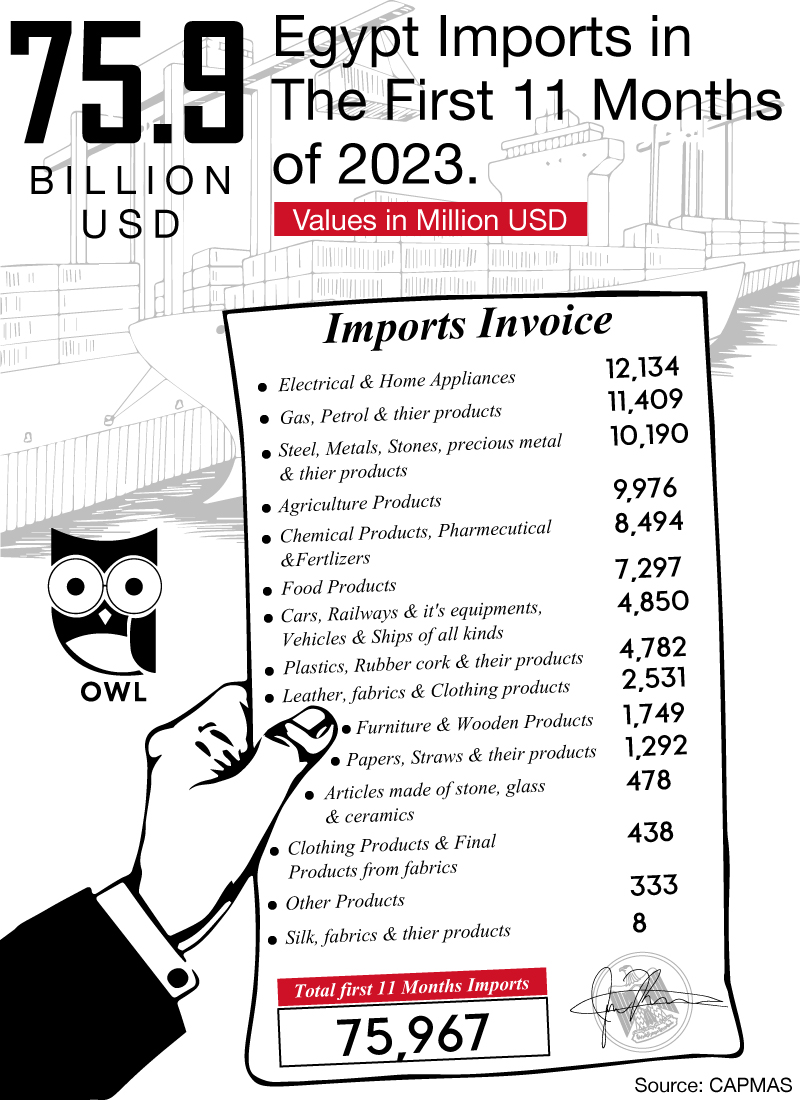
Key Figures & Statistics
- According to CAPMAS, Egypt’s total imports in 2023 dropped by ~ 12.5% compared to 2022, reaching about USD 84.2 billion (down from ~USD 96.2 billion). Amwal Al Ghad
- Non-petroleum imports also saw a decline: around USD 72.6 billion, a drop of ~12.2%. Petroleum & electricity-related imports fell to ~USD 11.7 billion. Amwal Al Ghad
Composition of Imports
By type/category, the first 11 months (and full year data) showed the following structure in import composition:
Some product-categories with significant drops included:
- Iron & steel imports fell ~11.6% year-on-year. Amwal Al Ghad
- Plastics imports dropped around ~28.3%. Amwal Al Ghad
- Wheat imports fell ~11.0%. Amwal Al Ghad
- Pharmaceuticals declined ~2.0%. Amwal Al Ghad
Major Suppliers
- China remained Egypt’s biggest supplier in 2023, contributing ~ 15.7% of total imports (~USD 13.2 billion), though down from USD 14.8 billion in 2022. Amwal Al Ghad
- Saudi Arabia came second, with ~ 6.6% of imports (~USD 5.5 billion), also declining from previous year levels. Amwal Al Ghad
Drivers Behind the Drop & Risks
- Currency depreciation — weaker Egyptian pound increased the cost of imports, prompting importers to reduce volumes.
- Inflation & Global Prices — rising costs of fuel, raw materials, and shipping made certain imports more expensive.
- Import Substitution & Domestic Policies — efforts to locally produce goods, or reduce import dependency, especially for energy and raw materials.
- Policy & Regulatory Shift — changes in licensing, custom duties, and stricter enforcement of standards.
- External Shocks — supply chain disruptions, geopolitical risks, and volatility of global markets.
Implications & Outlook
- Trade Deficit Pressure: With imports falling and exports also under strain, Egypt’s trade deficit remains a concern; balancing import needs with foreign exchange availability is critical.
- Consumer Impact: Declines in consumer goods imports may reflect higher prices or reduced availability, affecting cost of living and access to goods.
- Industrial Inputs: Reduced imports of plastics, steel, etc., could tighten supply for manufacturing, possibly slowing growth or raising local input costs.
- Policy Opportunity: This environment could push more investment into local manufacturing, modernization of supply chains, and incentives for domestic production.
Conclusion
In the first eleven months of 2023, Egypt’s imports contracted significantly, driven by energy, currency, and global economic headwinds. Intermediate goods still make up a large portion of what the country brings in, but critical sectors like plastics, steel, and wheat saw declines. China & Saudi Arabia remain major suppliers, even as volumes shift. For Egypt to stabilize its trade position, manage import costs, and protect consumers, policies targeting import substitution, improving manufacturing capacity, and controlling inflation will be essential.