Egypt’s education budget has expanded significantly over the past decade, but education spending as a share of GDP has continued to decline. This divergence highlights an important shift in the country’s public spending landscape.
Egypt’s education sector is undergoing a notable financial transformation. According to data from CAPMAS, the Information and Decision Support Center (IDSC), and the Ministry of Finance (MOF), government expenditure on education has increased substantially in nominal terms, rising from EGP 92.3 billion in 2014/15 to EGP 315.1 billion in 2025/26.
However, despite this increase, education expenditure as a percentage of Egypt’s GDP has moved in the opposite direction, declining from 3.8% to 1.5% over the same period.
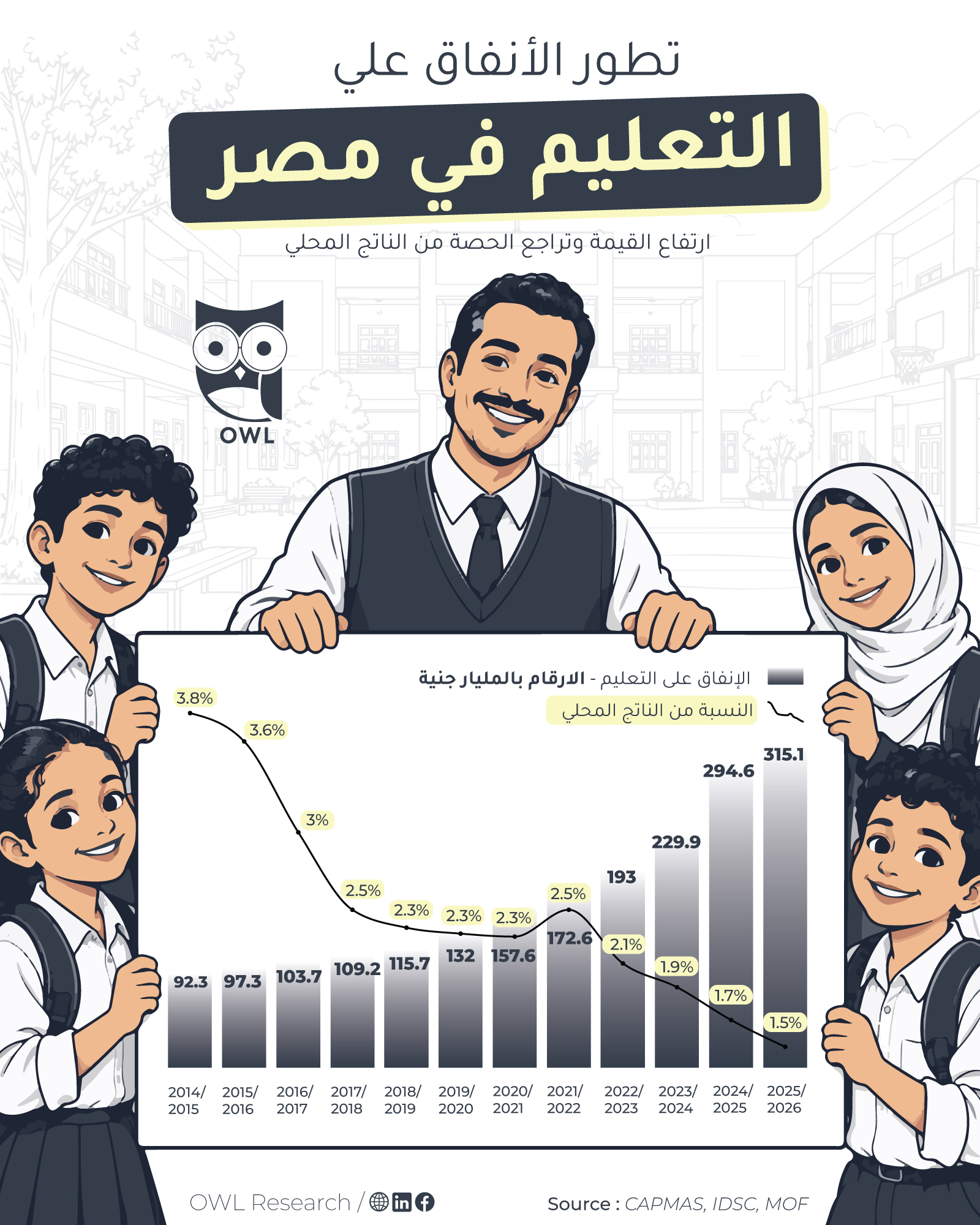
Education Spending Has More Than Tripled
Government spending on education increased from EGP 92.3 billion in 2014/15 to EGP 315.1 billion in 2025/26, representing an increase of more than three times over the period.
The growth has accelerated particularly in recent years:
- 2014/15: EGP 92.3 billion
- 2018/19: EGP 115.7 billion
- 2020/21: EGP 157.6 billion
- 2022/23: EGP 193.0 billion
- 2023/24: EGP 229.9 billion
- 2024/25: EGP 294.6 billion
- 2025/26: EGP 315.1 billion
The sharpest recent increase came between 2023/24 and 2024/25, when education spending rose from EGP 229.9 billion to EGP 294.6 billion.
This reflects the growing nominal value of public expenditure allocated to the education system, including spending across different levels of education and related public services.
But Education’s Share of GDP Has Declined
While the nominal education budget has increased, its contribution relative to the size of the economy has followed a different trajectory.
Education spending represented 3.8% of GDP in 2014/15, before gradually declining to:
- 3.6% in 2015/16
- 3.0% in 2016/17
- 2.5% in 2017/18
- 2.3% in 2018/19
- 2.3% in 2019/20
- 2.3% in 2020/21
- 2.5% in 2021/22
- 2.1% in 2022/23
- 1.9% in 2023/24
- 1.7% in 2024/25
- 1.5% in 2025/26
The data therefore points to a clear divergence: education spending is rising in absolute terms, while its relative weight in the economy is falling.
Why Does This Matter?
Looking only at the headline budget can give an incomplete picture of public investment in education.
An increase in nominal spending does not necessarily mean that education is receiving a larger share of national economic resources. GDP growth, inflation, population growth and changes in the overall government budget can all affect how education expenditure should be interpreted.
For policymakers, businesses and education stakeholders, the relationship between absolute spending and spending intensity is therefore an important indicator.
A growing education budget may provide additional resources for schools, universities, teachers, infrastructure and educational programmes. At the same time, a declining share of GDP raises questions about how education is positioned within the broader allocation of economic resources.
A Changing Education Landscape
Egypt’s education system serves a large and growing population, making the efficiency and allocation of public resources increasingly important.
The trend observed over the past decade suggests that the conversation around education finance should move beyond one simple question: “How much is being spent?”
A broader assessment should also consider:
- How much is spent per student
- The distribution of spending across education levels
- Teacher compensation and workforce requirements
- Investment in educational infrastructure
- Digital transformation and technology
- Learning outcomes and educational quality
- The role of private-sector spending
- Regional and socioeconomic differences in access to education
These indicators can provide a more complete understanding of whether increased financial resources are translating into stronger educational capacity and outcomes.
The Bigger Picture
Egypt’s education spending story is ultimately a story of scale versus economic share.
The government’s education expenditure has grown from EGP 92.3 billion to EGP 315.1 billion over the period covered. Yet, as a percentage of GDP, education spending has declined from 3.8% to 1.5%.
This contrast highlights why public spending data needs to be viewed through multiple lenses. Nominal budgets show the amount being allocated, while expenditure-to-GDP ratios provide context on the relative economic priority of a sector.
For researchers, investors, education providers and policymakers, tracking both indicators can offer a more meaningful perspective on the evolution of Egypt’s education sector.
Key Takeaway
Egypt is spending significantly more on education in nominal terms, but education expenditure represents a smaller share of the national economy than it did a decade ago.
Understanding what is driving this gap, and how additional spending translates into educational outcomes, will be critical to assessing the future trajectory of Egypt’s education sector.