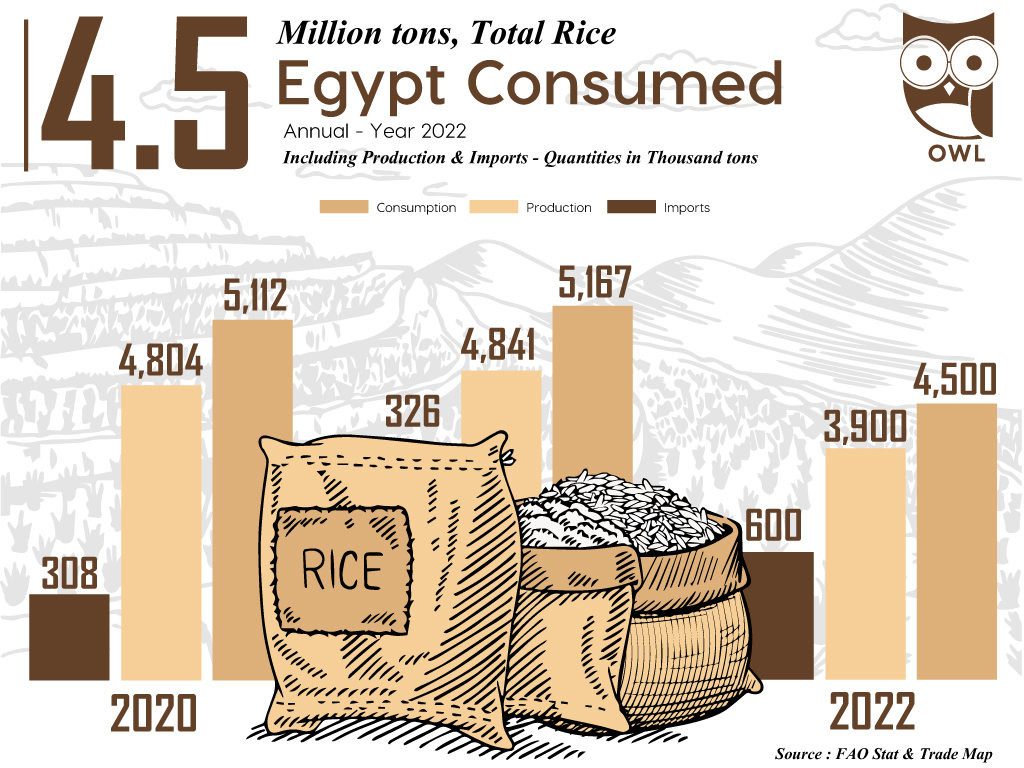
Rice is a staple food in Egypt, forming an essential part of the daily diet for millions of households. According to FAO and Trade Map data, Egypt consumed approximately 4.5 million tons of rice in 2022, highlighting the country’s reliance on both domestic production and imports to meet demand.
1. Rice Consumption and Production Trends
- 2020: Egypt consumed 4.8 million tons, with domestic production reaching 5.1 million tons and imports covering 308 thousand tons.
- 2021: Consumption rose to 4.8 million tons, with production slightly higher at 5.1 million tons, and imports increasing to 326 thousand tons.
- 2022: Consumption declined to 4.5 million tons, while production dropped to 3.9 million tons, forcing Egypt to import 600 thousand tons to fill the gap.
👉 This reflects a widening gap between local production and consumption needs, making imports increasingly important.
2. Why Did Rice Imports Increase in 2022?
Several factors contributed to the surge in rice imports:
- Reduced cultivation areas due to government restrictions on water-intensive crops.
- Rising local demand, particularly in urban areas.
- Global price fluctuations, pushing Egypt to diversify supply sources.
3. Impact on Egyptian Households
- Price fluctuations: Reduced production and higher import volumes contributed to rising rice prices in Egyptian markets.
- Food security concerns: Rice is one of the most consumed staples in Egypt, and dependency on imports makes the country vulnerable to global supply chain disruptions.
- Policy responses: The government introduced measures to stabilize local markets, including stricter price controls and promoting efficient irrigation techniques for farmers.
4. Future Outlook for Rice in Egypt
To ensure sustainable rice supply, Egypt may need to:
- Invest in water-efficient rice varieties to reduce irrigation needs.
- Expand storage and logistics infrastructure to minimize post-harvest losses.
- Encourage domestic production incentives to reduce reliance on imports.
Final Thoughts
In 2022, Egypt consumed 4.5 million tons of rice, with imports rising sharply to 600 thousand tons due to a drop in domestic production. As demand for rice remains strong, Egypt’s long-term challenge will be to balance food security with water scarcity, ensuring affordability and stability for consumers.