Natural gas remains one of the most important energy sources powering the global economy. In 2024, a group of leading countries continued to dominate international gas exports, supplying trillions of cubic meters to global markets.
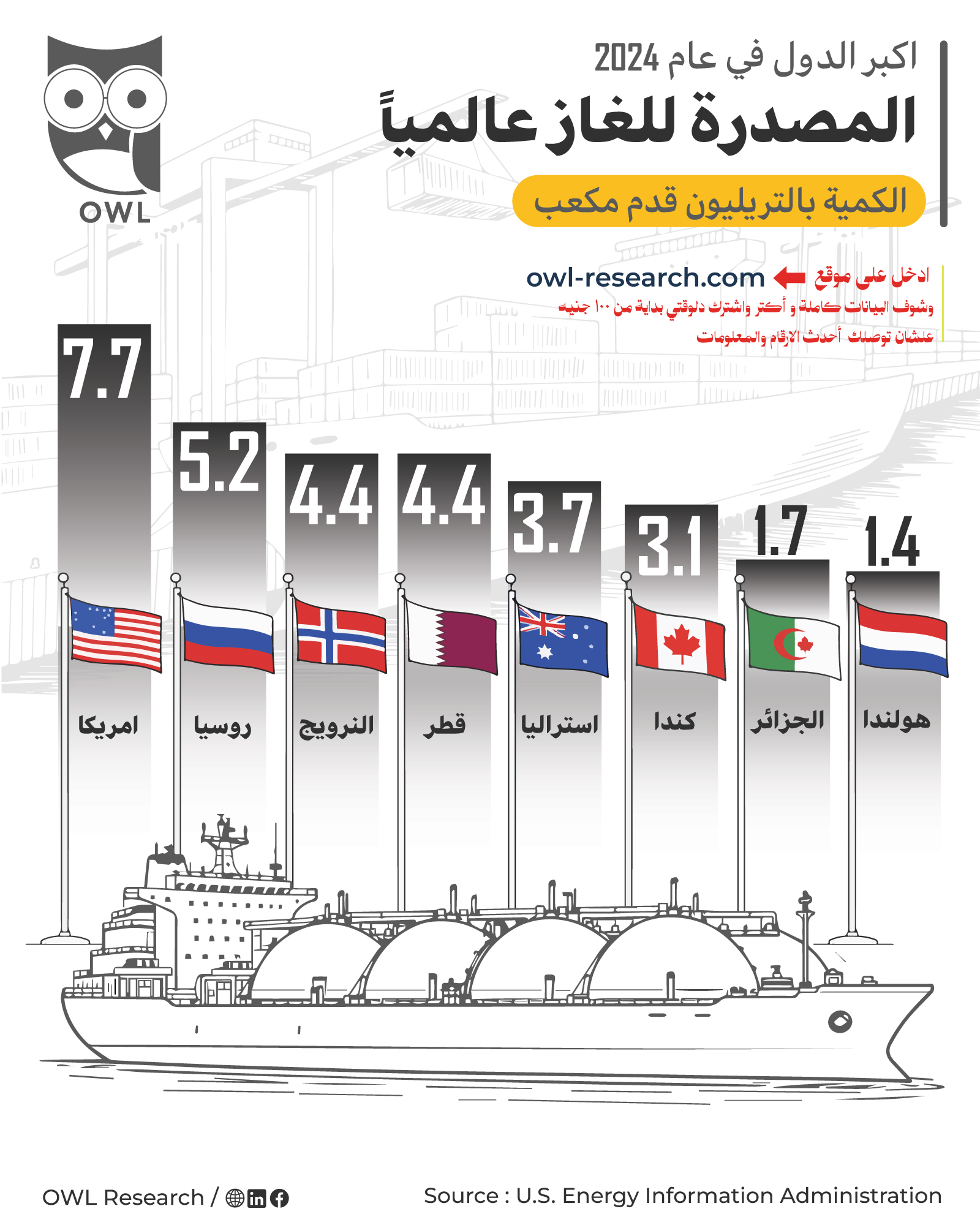
According to data from the U.S. Energy Information Administration (EIA), the United States leads the world in natural gas exports with 7.7 trillion cubic feet, driven largely by the expansion of liquefied natural gas (LNG) infrastructure and strong international demand.
Russia follows with 5.2 trillion cubic feet, maintaining its role as a major supplier despite shifting geopolitical dynamics and evolving trade routes.
Norway and Qatar each exported approximately 4.4 trillion cubic feet, highlighting their importance in supplying energy to Europe and Asia. Norway’s pipeline network plays a crucial role in European energy security, while Qatar continues to expand its LNG production capacity.
Australia exported 3.7 trillion cubic feet, supported by its large LNG terminals that primarily serve Asian markets.
Canada exported 3.1 trillion cubic feet, with most of its gas flowing through pipelines to the United States.
Other notable exporters include Algeria (1.7 trillion cubic feet) and the Netherlands (1.4 trillion cubic feet), both important suppliers to European markets.
As global energy demand continues to grow and the transition toward cleaner fuels accelerates, natural gas is expected to remain a critical bridge fuel in the global energy mix. The dominance of these exporters highlights how energy production, infrastructure, and geopolitics continue to shape international energy markets.