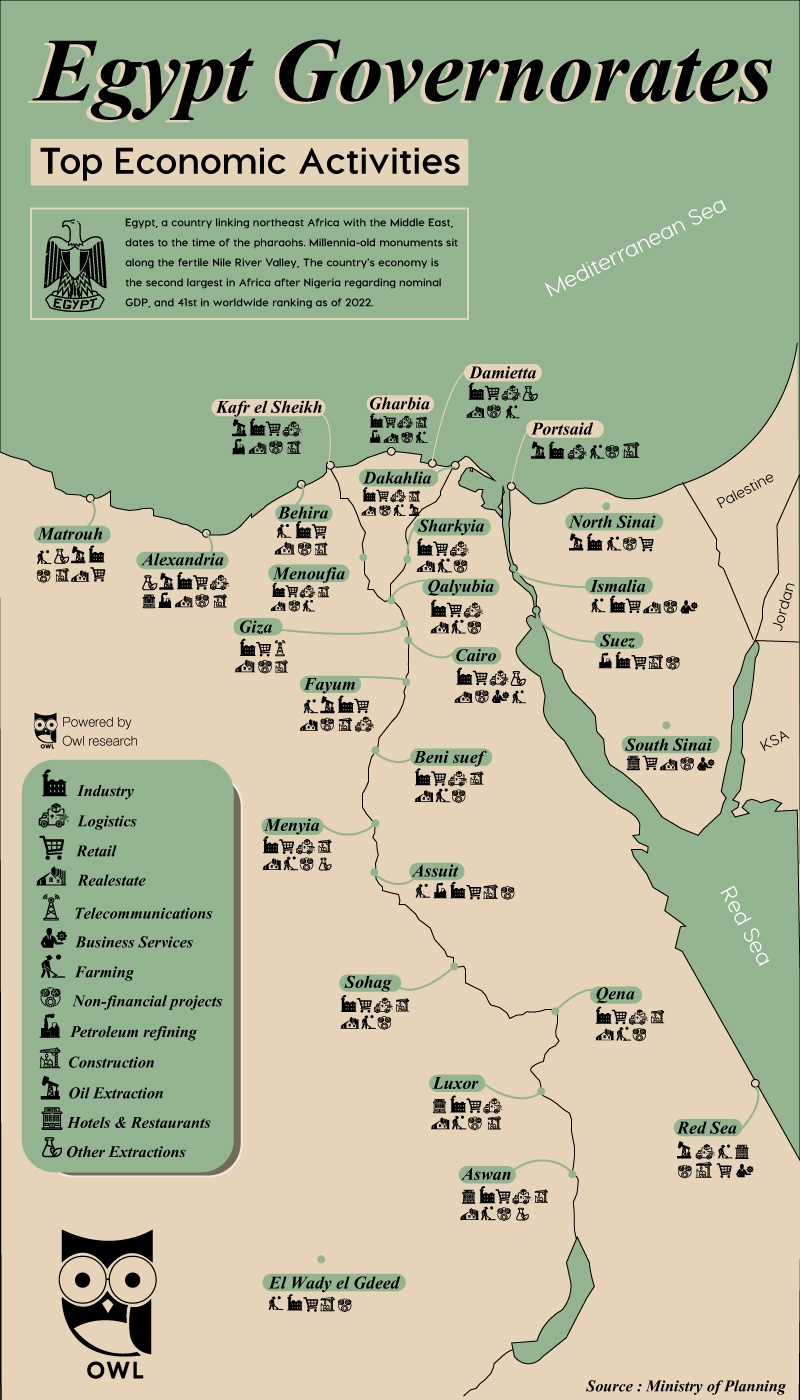
Egypt, a country that bridges North Africa and the Middle East, has one of the largest economies in Africa, ranking second after Nigeria in terms of nominal GDP and 41st worldwide as of 2022. Each governorate within Egypt contributes uniquely to the national economy, with activities spanning industry, agriculture, logistics, real estate, and tourism.
1. Cairo: The Economic Heart
As the capital, Cairo dominates in industry, retail, logistics, real estate, telecommunications, and business services. It remains the central hub for commerce, administration, and financial services in Egypt.
2. Alexandria: Industry and Logistics
Egypt’s second-largest city, Alexandria, is vital for industry, logistics, hotels, and restaurants, thanks to its strategic port on the Mediterranean. It plays a crucial role in foreign trade and shipping.
3. Canal Zone Governorates: Suez, Ismailia, and Port Said
- Suez: Known for oil extraction, logistics, and industry, powered by its proximity to the Suez Canal.
- Ismailia: Focused on agriculture, logistics, and services, making it an agricultural hub.
- Port Said: A major logistics and retail hub, benefiting from free trade zones and canal activity.
4. Delta Governorates: Agriculture and Industry
- Dakahlia, Beheira, and Kafr El-Sheikh: Strong in farming, fisheries, and industry.
- Sharqiya and Gharbia: Agriculture dominates, alongside manufacturing.
- Menoufia and Qalyubia: Mix of agriculture, industry, and services.
5. Upper Egypt: Agriculture, Mining, and Tourism
- Minya, Assiut, and Sohag: Combine agriculture, construction, and industry, with growing non-financial projects.
- Luxor and Aswan: Globally recognized for tourism, hotels, restaurants, and cultural heritage, while also contributing through farming and mining.
- Qena: Focus on industry, retail, and agriculture.
6. Red Sea and Sinai Governorates
- Red Sea: Specializes in tourism, petroleum refining, and mining, leveraging its coastal resorts.
- South Sinai and North Sinai: Known for tourism, logistics, and construction projects, with South Sinai being a premier tourist destination (Sharm El-Sheikh).
7. Fayoum and El Wady El Gedid
- Fayoum: Primarily agriculture, industry, and services.
- El Wady El Gedid: Known for mining, farming, and oil extraction, contributing to Egypt’s resource economy.
Key Insights
- Industry and farming remain the backbone of most governorates, especially in the Nile Delta and Upper Egypt.
- Tourism and hospitality dominate in Luxor, Aswan, South Sinai, and the Red Sea governorates.
- Logistics and oil-related activities are strongest in Suez and Red Sea regions.
- Cairo and Alexandria lead in services, finance, and international trade.
Final Thoughts
Egypt’s economic strength lies in its diverse regional contributions. While Cairo and Alexandria remain commercial and industrial powerhouses, the Canal Zone ensures Egypt’s role in global logistics, and Upper Egypt drives tourism and cultural heritage. With farming, industry, and oil extraction spread across various regions, Egypt’s governorates collectively form a balanced and multi-sector economy.