How Much Does a Liter of Fuel Represent From Your Salary?
A Comparative Look Across the Arab World
Fuel prices are one of the most direct costs that affect people’s daily lives—especially in countries where private cars are the primary mode of transportation. But the real question isn’t just “How much does fuel cost?” It’s “How much does fuel cost compared to the average salary in each country?”
To understand this, OWL Research analyzed the relationship between the minimum monthly wage and the price of one liter of gasoline across several Arab countries.
The result provides a clearer picture of purchasing power, living standards, and how affordable transportation really is.

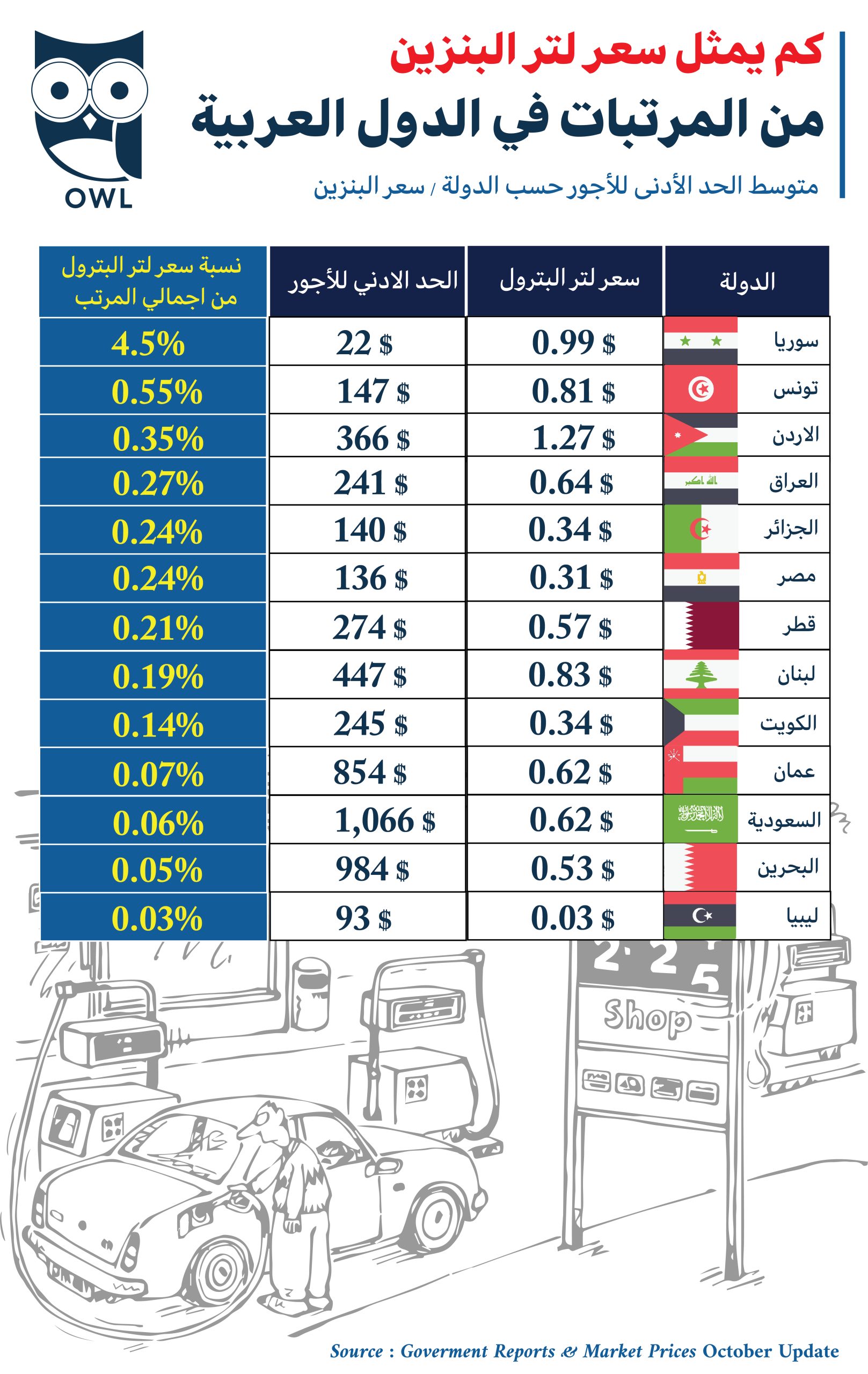
🔍 Key Insights
- Syria has the highest fuel burden, where the price of one liter represents 4.5% of the minimum wage. This is extremely high and reflects broader economic challenges.
- Tunisia, Jordan, Iraq, Algeria, and Egypt fall within a more moderate range (0.24%–0.55%), showing a more balanced relationship between wages and fuel prices.
- GCC countries—such as Saudi Arabia, Oman, Kuwait, Qatar, and Bahrain—enjoy some of the smallest ratios globally. In these nations, one liter of gasoline represents less than 0.1% of the minimum wage.
- Libya stands out with one of the lowest gasoline prices worldwide; a liter represents only 0.03% of monthly income.
📌 What This Means
These numbers highlight important differences in:
- Fuel subsidy policies
- Income levels
- Cost of living
- Government support systems
Countries with high ratios experience greater financial pressure on citizens, especially commuters.
Countries with low ratios benefit from strong wage levels and/or subsidized fuel markets.
💬 What do you think?
How much of your salary goes toward fuel each month?
And do you believe your country’s fuel policy reflects economic reality?
Share your thoughts—we’d love to hear your perspective.