The FIFA World Cup 2026 is more than a global sporting event. For the Arab world, it represents a significant economic opportunity, with multiple national teams competing on football’s biggest stage and generating substantial financial returns through participation and performance.
The 2026 tournament features a record 48 teams, with FIFA guaranteeing each participating association at least USD 10.5 million, including USD 9 million in prize money and USD 1.5 million allocated for preparation costs.
Eight Arab Teams, A Growing Financial Opportunity
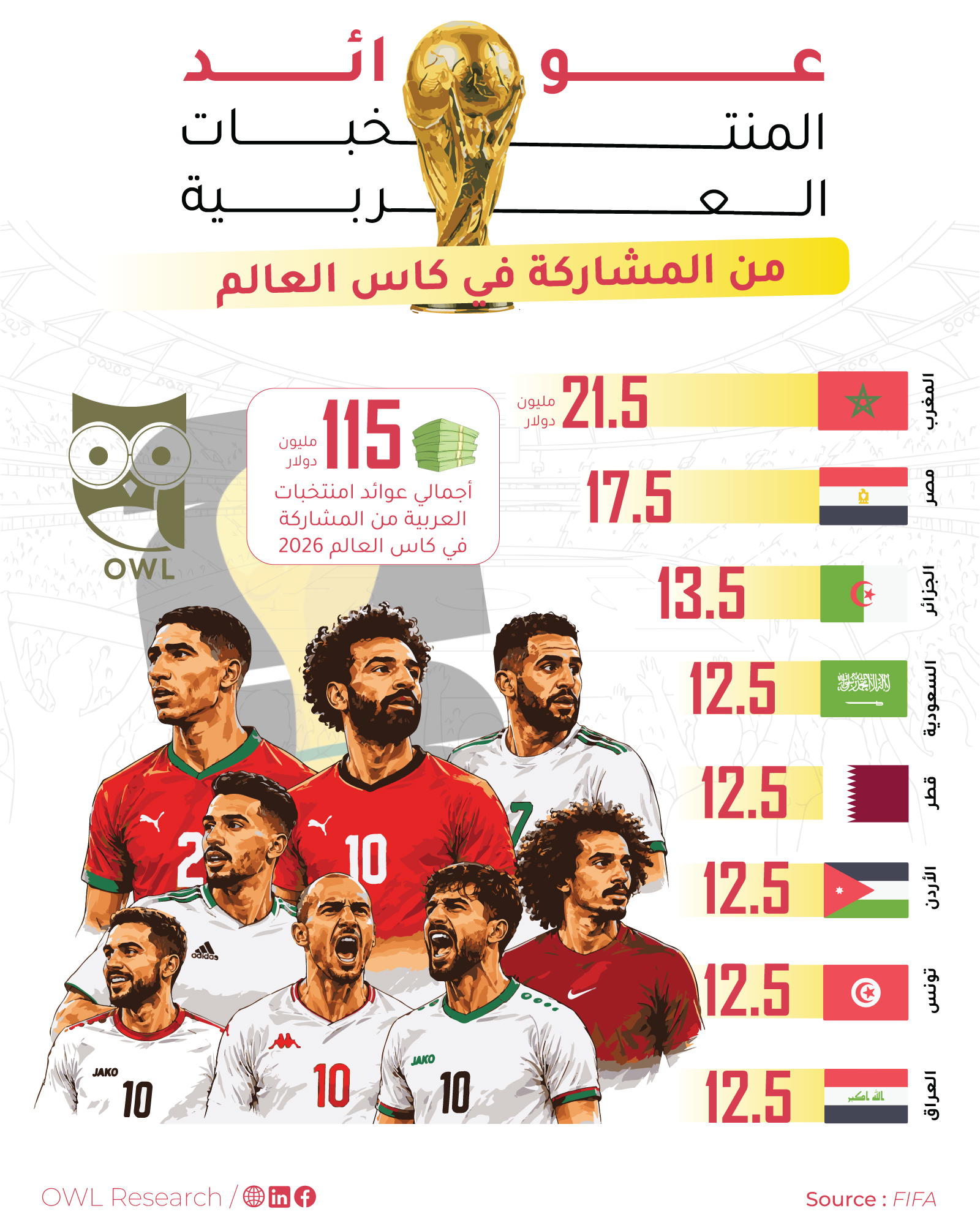
The participation of Arab teams highlights the increasing presence of the region in global football. Morocco, Egypt, Algeria, Saudi Arabia, Qatar, Jordan, Tunisia and Iraq all feature among the Arab representatives at the tournament.
Based on the financial distribution associated with the 2026 World Cup, Arab teams collectively stand to generate significant revenues from their participation and progression in the competition.
According to the figures presented in our analysis, Morocco leads the Arab teams with approximately USD 21.5 million, followed by Egypt at USD 17.5 million and Algeria at USD 13.5 million.
Saudi Arabia follows with approximately USD 12.5 million, while Qatar, Jordan, Tunisia and Iraq each record around USD 12.5 million in the analysis.
Beyond Prize Money
The financial impact of World Cup participation extends beyond FIFA’s direct payments.
For national football associations, qualification can generate additional value through:
- Sponsorship and commercial partnerships
- Broadcasting and media exposure
- Merchandise and licensing
- Increased tourism and fan engagement
- Brand visibility for players and national teams
- Greater international exposure for domestic football
This makes the World Cup an important commercial platform, not simply a sporting competition.
The scale of FIFA’s 2026 financial distribution reinforces this opportunity. FIFA has described the tournament’s financial contribution as a record-breaking one, with total prize money reaching USD 727 million, alongside additional preparation and participation payments.
Morocco Leads the Arab Ranking
Morocco’s position at the top of the Arab ranking reflects the country’s growing influence in international football.
Following the national team’s historic run to the semi-finals of the 2022 World Cup, Moroccan football has gained significantly greater global visibility. This sporting momentum can translate into stronger commercial opportunities, particularly around sponsorship, player branding and international partnerships.
Egypt ranks second in the infographic, highlighting the country’s continued importance in the Arab football market and its large domestic and regional fan base.
Football as an Economic Asset
The growing financial value of World Cup participation demonstrates how football has evolved into a broader economic ecosystem.
For Arab markets, international football success can strengthen national brand visibility, create commercial opportunities and increase engagement across media, sponsorship and consumer markets.
As football continues to attract massive global audiences, the value generated by national teams is increasingly measured not only by trophies and results, but also by their ability to create economic, commercial and cultural impact.
Owl Research Perspective
At OWL Research, we believe major sporting events provide valuable opportunities to understand consumer behaviour, brand exposure and market dynamics.
The FIFA World Cup 2026 offers a particularly interesting case study for the Arab region, where football intersects with consumer engagement, media consumption, sponsorship, national branding and commercial value.
The game may be played on the pitch, but its economic impact extends far beyond it.