The global oil market is deeply connected to the Gulf region. Despite the growing transition toward renewable energy and alternative sources of power, crude oil and condensates remain critical to the global economy, particularly across Asia.
The Gulf’s strategic importance is reflected in its role as a major supplier to some of the world’s largest energy-consuming economies.
According to data from the U.S. Energy Information Administration (EIA), Gulf oil exports and condensates continue to play a significant role in supplying Asian markets, highlighting the region’s importance to global energy security.
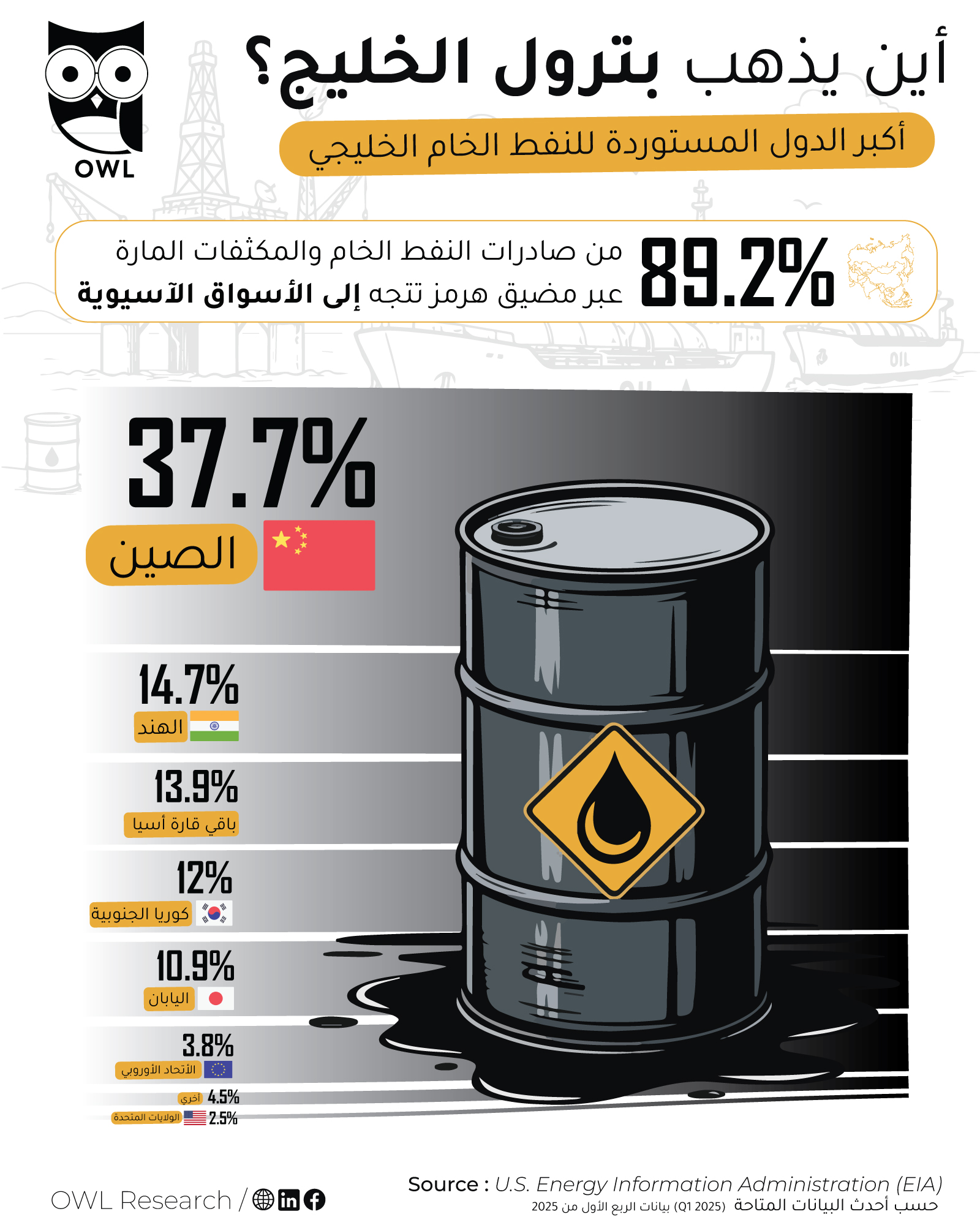
Asia Remains the Gulf’s Key Market
China is the largest destination, accounting for approximately 37.7% of crude oil and condensate exports from the Gulf.
India follows with 14.7%, while other Asian markets collectively account for another 13.9%.
South Korea represents approximately 12%, followed by Japan at 10.9%.
Together, these figures demonstrate how heavily Asian economies depend on energy flows originating from the Gulf.
The relationship is particularly important because China, India, Japan and South Korea are among the world’s largest energy-consuming economies. Their industrial activity, transportation systems and manufacturing sectors remain closely linked to reliable oil supplies.
Why the Gulf Matters to Global Energy Security
The Gulf’s importance extends beyond the volume of oil it produces.
Its geographic position connects major producers with some of the world’s largest consumers, making the region a critical component of international energy trade.
The Strait of Hormuz, in particular, represents one of the world’s most important energy chokepoints, through which a significant share of globally traded oil and LNG passes.
This means that developments affecting Gulf production, exports or shipping routes can have consequences well beyond the region itself.
China at the Centre of Gulf Oil Demand
China’s position as the largest destination for Gulf crude highlights the country’s growing importance in global energy markets.
Its massive industrial base, transportation demand and refining capacity have made China a major driver of global oil consumption.
For Gulf producers, maintaining access to the Chinese market therefore remains strategically important.
At the same time, China’s growing economic influence gives it an increasingly significant role in shaping global energy trade flows.
A Market Still Dominated by Asia
The infographic shows that Asian markets account for the overwhelming majority of Gulf crude oil and condensate exports, while destinations such as the European Union and the United States represent much smaller shares.
The European Union accounts for approximately 3.8%, while the United States represents around 2.5%.
This illustrates a fundamental shift in the geography of global oil demand: the centre of gravity of Gulf oil exports is firmly positioned in Asia.
The Bigger Picture
The Gulf’s role in global energy markets is not simply about producing oil. It is about connecting some of the world’s largest energy reserves with some of its largest consumers.
As the global energy system evolves, the Gulf will increasingly need to balance traditional hydrocarbon revenues with investments in diversification, technology and new energy sources.
Yet for the foreseeable future, the region’s oil exports will remain a critical component of global energy security, particularly for Asia.
OWL Research Perspective
At OWL Research, we look beyond headline numbers to understand the structural forces shaping markets.
The geography of Gulf oil exports provides a clear example of how energy, trade, geopolitics and economic growth are interconnected.
As Asian economies continue to drive global energy demand, the Gulf is likely to remain at the centre of the world’s energy map.
The question is not simply where the oil comes from. It is where global demand is heading.