As countries around the world accelerate their shift toward renewable energy and lower carbon emissions, coal continues to maintain a significant position as one of the world’s primary energy sources — particularly in major industrial economies and densely populated nations.
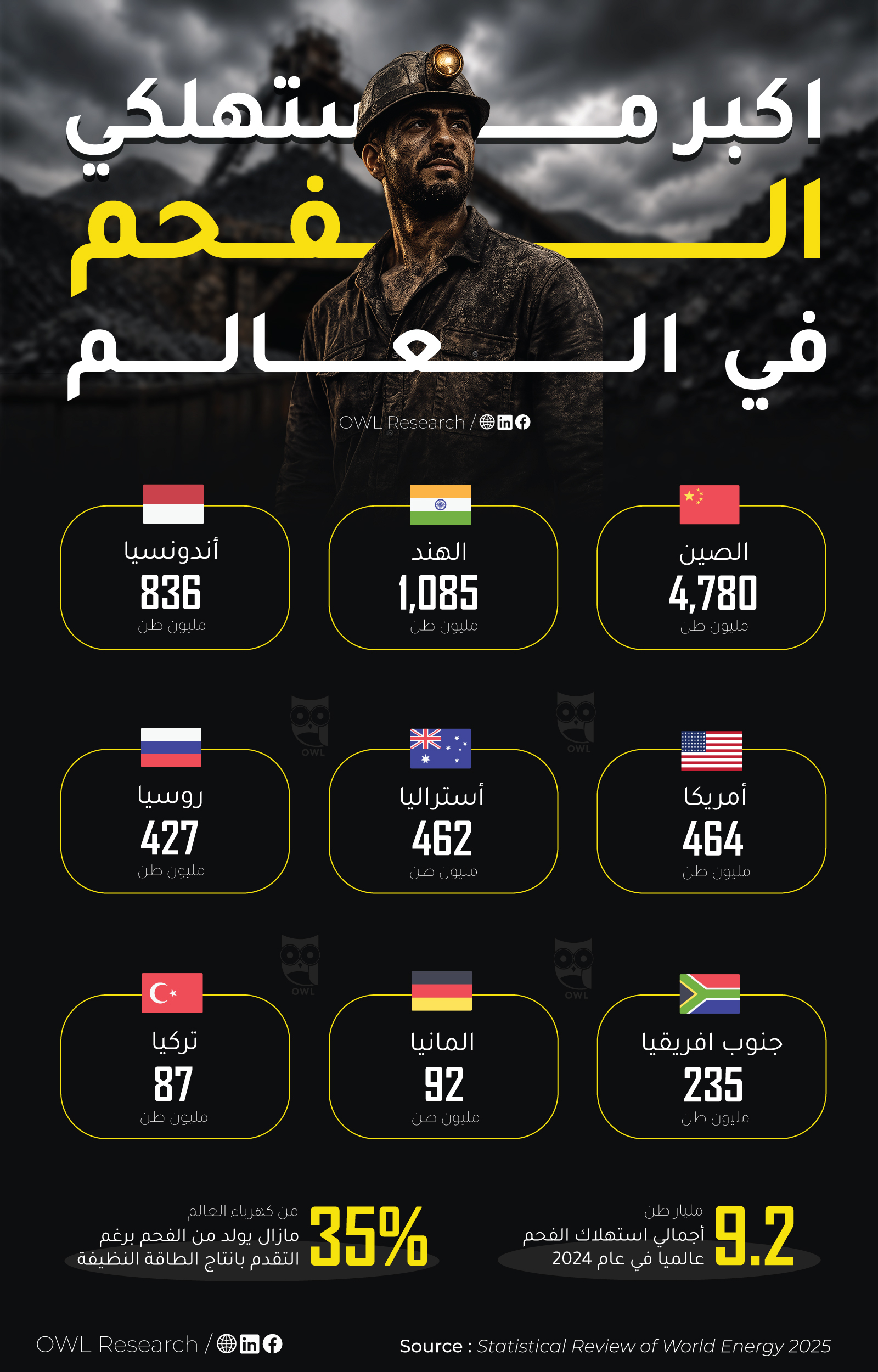
According to the Statistical Review of World Energy 2025, global coal consumption reached approximately 9.2 billion tons in 2024, highlighting the continued reliance on traditional energy sources despite rapid investments in clean energy technologies.
China Remains the Largest Coal Consumer
China continues to dominate global coal consumption, recording nearly 4.78 billion tons, driven by its massive industrial sector and strong dependence on coal-fired electricity generation.
India ranked second with approximately 1.085 billion tons, supported by rapid population growth and ongoing industrial expansion. Indonesia followed in third place with around 836 million tons, benefiting from its mining industry and export-oriented industrial activities.
Major Economies Still Depend on Coal
Despite increasing commitments to carbon neutrality, several advanced economies continue to rely heavily on coal within their energy mix. The United States consumed approximately 464 million tons, while Australia recorded 462 million tons, and Russia reached 427 million tons.
These figures reflect the complex global challenge of balancing economic growth with sustainability and climate goals.
Europe Continues Gradual Reduction
On the other hand, several European countries are moving more aggressively toward reducing coal dependency. Germany’s coal consumption stood at around 92 million tons, supported by ongoing renewable energy policies and environmental regulations.
Turkey recorded approximately 87 million tons, while South Africa consumed nearly 235 million tons, largely due to its heavy dependence on coal for electricity production.
Will Coal Disappear Anytime Soon?
Despite the remarkable growth of solar, wind, and green hydrogen projects worldwide, coal still generates nearly 35% of global electricity production today.
Energy experts argue that a complete phase-out of coal is unlikely to happen quickly, particularly in developing economies that continue to require affordable and stable energy sources to support industrial growth and rising electricity demand.
As the global energy transition continues, one critical question remains:
Will renewable energy successfully reduce coal’s dominance over the coming years, or will fossil fuels remain a core pillar of the global economy longer than expected?