Egypt’s tourism sector continues to demonstrate remarkable resilience and recovery, reinforcing its position as one of the country’s most important sources of foreign currency and economic growth.
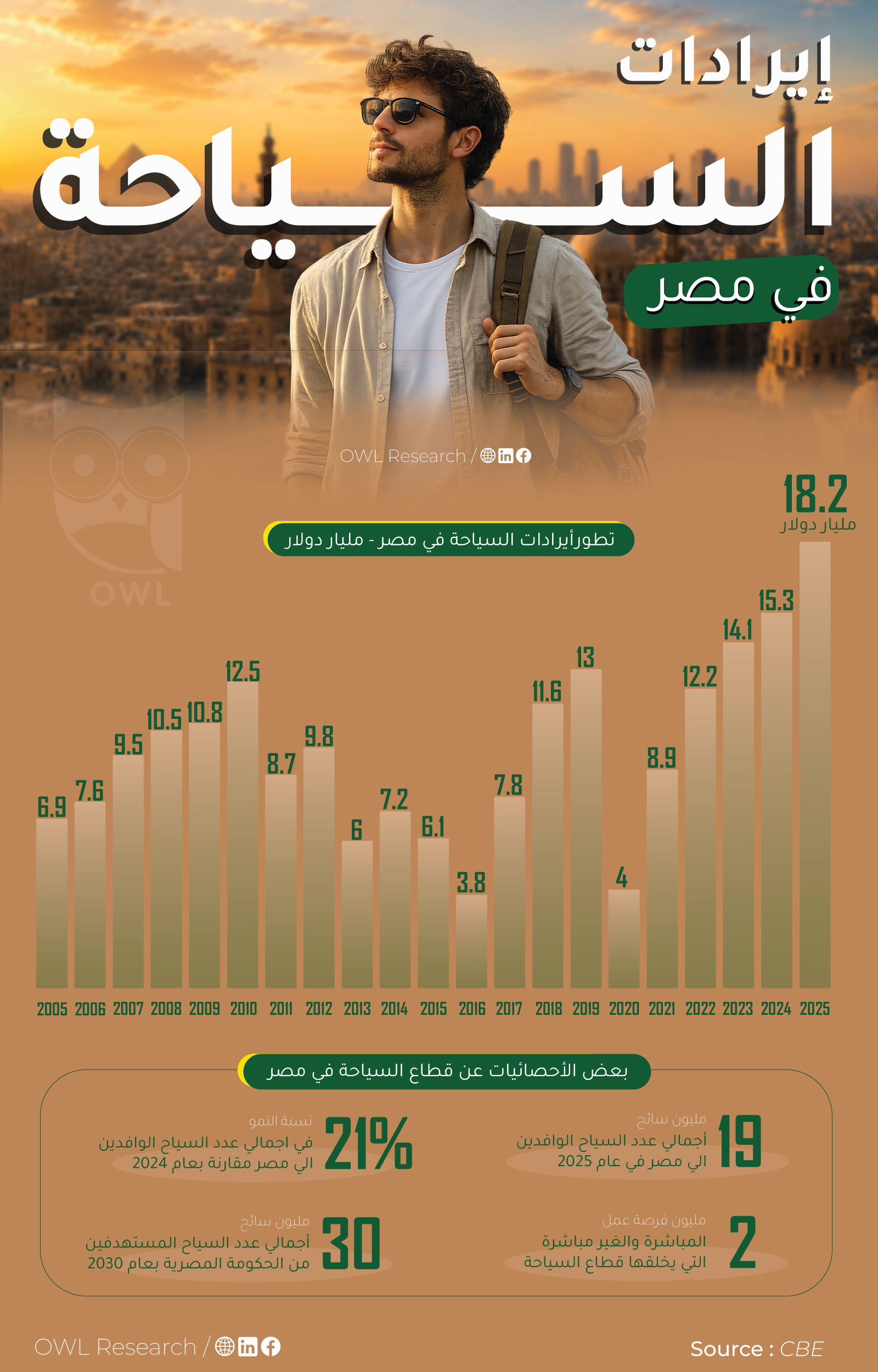
According to recent data from the Central Bank of Egypt (CBE), tourism revenues are expected to reach approximately USD 18.2 billion in 2025, marking the highest level recorded in recent years and reflecting the sector’s accelerating recovery after years of global and regional challenges.
A Decade of Growth and Recovery
Over the past two decades, Egypt’s tourism revenues have experienced several waves of growth, volatility, and recovery driven by political, economic, and global developments.
Tourism revenues increased steadily from USD 6.9 billion in 2005 to nearly USD 12.5 billion in 2010, before facing fluctuations during periods of regional instability.
The sector later regained momentum, achieving USD 13 billion in 2019, before the global COVID-19 pandemic caused revenues to decline sharply to nearly USD 4 billion in 2020.
Since then, the tourism industry has witnessed a strong rebound:
- USD 8.9 billion in 2021
- USD 12.2 billion in 2022
- USD 14.1 billion in 2023
- USD 15.3 billion in 2024
- Expected to reach USD 18.2 billion in 2025
This consistent upward trajectory highlights Egypt’s growing attractiveness as a global tourism destination.
Tourism Remains a Key Economic Pillar
Tourism plays a strategic role within the Egyptian economy, not only as a source of foreign exchange revenues but also as a major employment generator across multiple industries.
Current estimates indicate that the tourism sector supports nearly 2 million direct and indirect jobs, spanning hospitality, transportation, entertainment, retail, and related services.
In addition, Egypt welcomed approximately 19 million tourists in 2025, reflecting a significant increase in international visitor arrivals compared to previous years.
Government Ambitions for 2030
The Egyptian government continues to prioritize tourism development as part of its broader economic growth strategy.
National targets aim to attract nearly 30 million tourists annually by 2030, supported by:
- Expanding tourism infrastructure
- Developing new destinations
- Increasing hotel capacity
- Enhancing aviation connectivity
- Promoting cultural and coastal tourism
- Encouraging private sector investment
Large-scale projects across the Red Sea coast, the North Coast, and Upper Egypt are also expected to strengthen Egypt’s competitiveness in the global tourism market.
Challenges and Opportunities Ahead
Despite the sector’s positive momentum, several challenges remain, including global economic uncertainty, geopolitical tensions, and increasing competition among international tourism destinations.
However, Egypt’s unique combination of historical heritage, cultural diversity, coastal destinations, and competitive pricing continues to provide strong long-term growth potential.
As global tourism demand continues to recover, Egypt appears well-positioned to further expand its share within the international tourism industry over the coming years.