Oil production remains a critical driver of the global economy, shaping energy markets, trade balances, and geopolitics. In 2023, global oil output was dominated by a handful of producers, led by the United States, Russia, and Saudi Arabia. According to the US Energy Information Administration, these three nations alone accounted for more than one-third of the world’s crude oil supply.
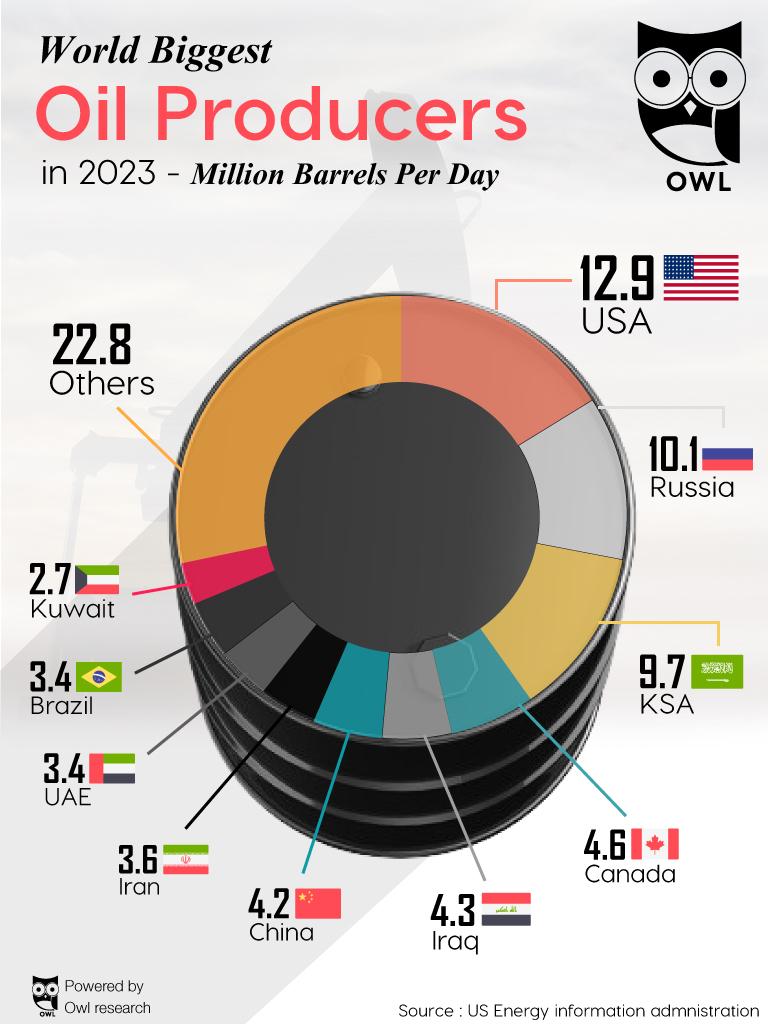
1. Top Oil Producers in 2023 (Million Barrels Per Day)
- USA: 12.9 mb/d
- Russia: 10.1 mb/d
- Saudi Arabia (KSA): 9.7 mb/d
- Canada: 4.6 mb/d
- Iraq: 4.3 mb/d
- China: 4.2 mb/d
- Iran: 3.6 mb/d
- UAE: 3.4 mb/d
- Brazil: 3.4 mb/d
- Kuwait: 2.7 mb/d
- Others combined: 22.8 mb/d
👉 Together, these top producers account for the majority of global oil output, with “Others” contributing 22.8 million barrels per day, reflecting the importance of smaller producing nations.
2. USA: The Global Leader
The United States remained the largest oil producer in 2023, producing 12.9 million barrels per day. Its dominance is largely due to shale oil and technological advancements in hydraulic fracturing, making it less dependent on imports and turning it into a net energy exporter.
3. Russia: Sanctions but Still Strong
Despite facing Western sanctions and geopolitical challenges following the war in Ukraine, Russia continued to produce 10.1 mb/d, maintaining its position as the second largest oil producer in the world.
4. Saudi Arabia: OPEC’s Backbone
As OPEC’s largest producer, Saudi Arabia contributed 9.7 mb/d. The kingdom’s production policies significantly influence global oil prices, given its ability to adjust output as part of OPEC+ agreements.
5. Other Key Producers
- Canada (4.6 mb/d): Benefits from its oil sands reserves.
- Iraq (4.3 mb/d): One of OPEC’s largest and fastest-growing producers.
- China (4.2 mb/d): A major consumer and producer, but still heavily reliant on imports.
- Iran (3.6 mb/d): Despite sanctions, maintained steady production, exporting mainly to Asian markets.
- UAE & Brazil (3.4 mb/d each): Both countries continue to expand offshore production.
- Kuwait (2.7 mb/d): Remains a stable OPEC contributor with vast reserves.
6. Global Market Implications
- The USA, Russia, and Saudi Arabia continue to set the tone for oil markets.
- OPEC members (Saudi Arabia, Iraq, Iran, UAE, Kuwait) collectively remain pivotal in balancing supply.
- Geopolitical tensions, energy transition policies, and climate concerns may reshape future production trends.
Final Thoughts
In 2023, the United States (12.9 mb/d), Russia (10.1 mb/d), and Saudi Arabia (9.7 mb/d) led the world’s oil production, while Canada, Iraq, and China followed closely behind. Together, the top 10 producers supplied most of the world’s oil, underscoring their influence on global energy security and economic stability.