Egypt’s ready-made garment exports grew by 16% year-on-year during the first eight months of 2026, while exports to Europe increased by 26%, highlighting the sector’s expanding international presence.
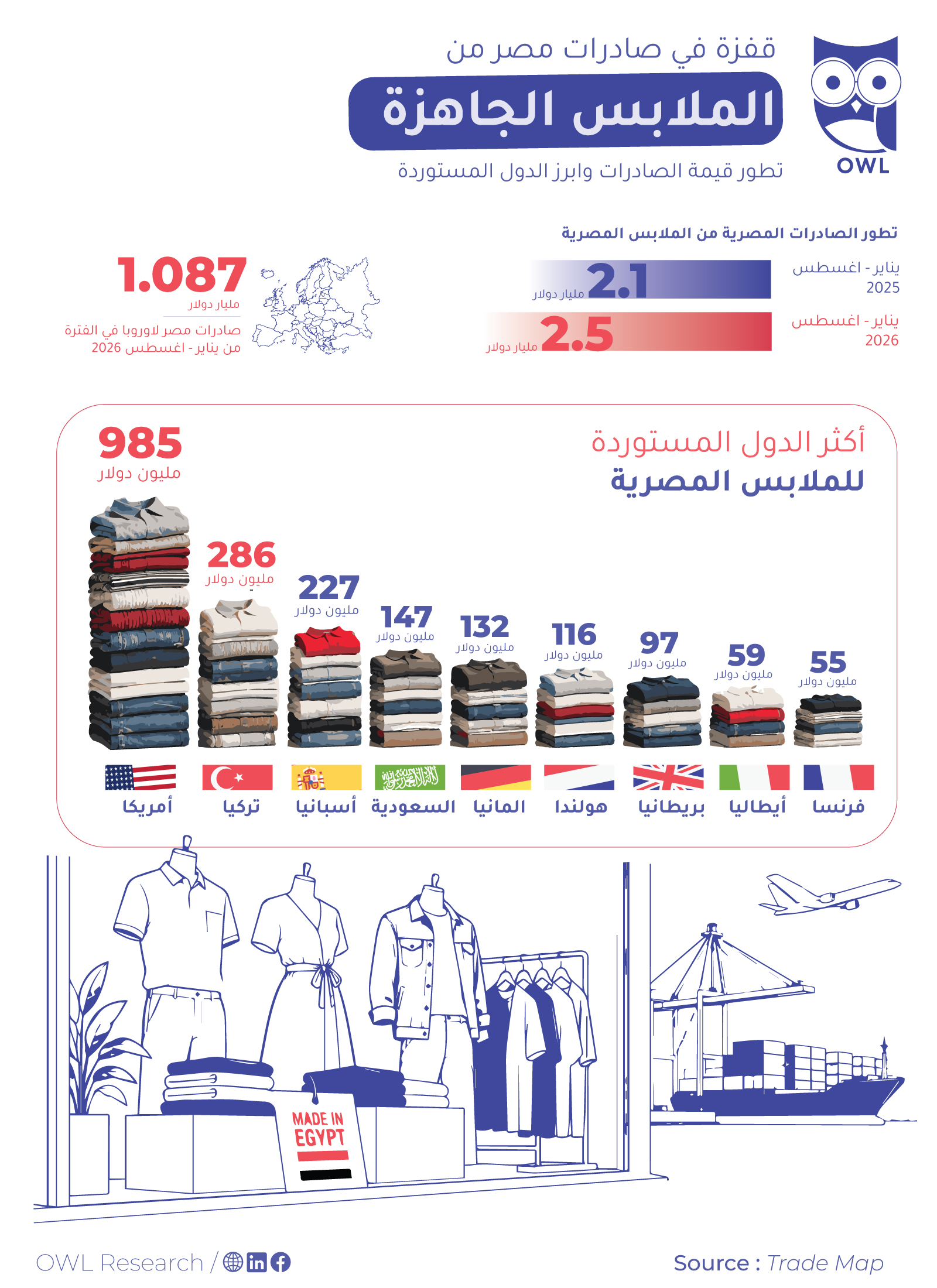
Egypt’s ready-made garment industry continues to strengthen its position in international markets. During the first eight months of 2026, the country’s ready-made garment exports reached approximately $2.53 billion, compared with around $2.18 billion during the same period in 2025, representing annual growth of 16%.
This performance highlights the sector’s growing importance to Egypt’s industrial and export landscape, particularly as global brands reassess their sourcing strategies and seek greater flexibility across international supply chains.
Europe Emerges as a Key Growth Market
Egyptian ready-made garment exports to European markets reached approximately $1.087 billion between January and August 2026, up 26% from approximately $861 million during the corresponding period in 2025.
Europe accounted for around 43% of the country’s total ready-made garment exports, reinforcing its position as the leading regional destination for Egyptian apparel products.
The region’s importance reflects several potential advantages for Egyptian manufacturers, including geographical proximity, shorter shipping routes to major European markets, and the ability to respond to changing sourcing requirements.
As international buyers increasingly prioritize supply chain resilience, delivery flexibility, and competitive production costs, Egypt has an opportunity to strengthen its role as a regional apparel manufacturing and sourcing hub.
The United States Leads Individual Export Destinations
At the country level, the United States remained Egypt’s largest individual export destination for ready-made garments, with exports reaching approximately $985 million during the first eight months of 2026, compared with around $875 million in the same period of the previous year.
Turkey ranked second, with imports of Egyptian ready-made garments valued at $286 million, followed by Spain at $227 million and Saudi Arabia at $147 million.
Germany recorded approximately $132 million in imports, followed by the Netherlands at $116 million, the United Kingdom at $97 million, Italy at $59 million, and France at $55 million.
These figures demonstrate the geographical diversity of Egypt’s export markets, spanning North America, Europe, and the Middle East. This diversification creates opportunities for manufacturers to expand their customer base and reduce their dependence on individual markets.
What Is Driving the Sector’s Export Potential?
The growth in ready-made garment exports points to several opportunities for Egypt’s apparel industry.
1. Strengthening international competitiveness
Sustained export growth creates opportunities for Egyptian manufacturers to build stronger relationships with international buyers and compete across different product categories and price segments.
2. Diversifying export destinations
A broader geographical footprint can help manufacturers manage demand fluctuations across markets while creating additional opportunities for long-term commercial partnerships.
3. Capitalizing on global sourcing shifts
As international brands seek to diversify their sourcing networks, Egyptian manufacturers may benefit from opportunities to serve markets that value geographical proximity, production flexibility, and reliable delivery schedules.
4. Encouraging industrial investment
Continued export demand can support investment in production capacity, operational efficiency, workforce capabilities, and product quality, helping manufacturers move toward higher-value activities.
What Should Businesses Watch Next?
Despite the positive export performance, sustaining growth will depend on several factors.
Demand conditions across major destination markets remain important, particularly as changes in consumer spending can influence apparel purchasing decisions. Manufacturers must also manage production costs, shipping expenses, quality requirements, and increasingly important environmental and sustainability standards.
Another strategic priority is moving beyond volume-driven growth. Developing stronger supplier relationships, improving production efficiency, and expanding into higher-value product categories could help Egyptian manufacturers strengthen their competitive position over the longer term.
For investors and industry stakeholders, the key question is whether the current export momentum can translate into sustained gains in industrial capacity, productivity, and value creation.
The Outlook: Turning Export Growth into Long-Term Competitiveness
Egypt’s ready-made garment export performance during January–August 2026 points to a positive trajectory for the industry. Total exports increased by 16%, while exports to Europe grew by 26%, reinforcing the importance of international markets to the sector.
With the United States maintaining its position as the largest individual destination and European and regional markets contributing to export diversification, Egypt has opportunities to deepen its participation in global apparel supply chains.
The next phase will depend on the industry’s ability to convert export growth into sustainable competitive advantages through investment, operational efficiency, product development, and stronger international partnerships.