A proposed European Union measure could disrupt Egypt’s access to imported steel scrap, putting pressure on raw material costs, supply chains, and the competitiveness of domestic steel manufacturers.
Egypt’s steel industry faces a potential supply chain challenge following the European Commission’s proposal to restrict exports of certain metal waste to countries that are not authorized to receive it under the EU’s revised Waste Shipment Regulation.
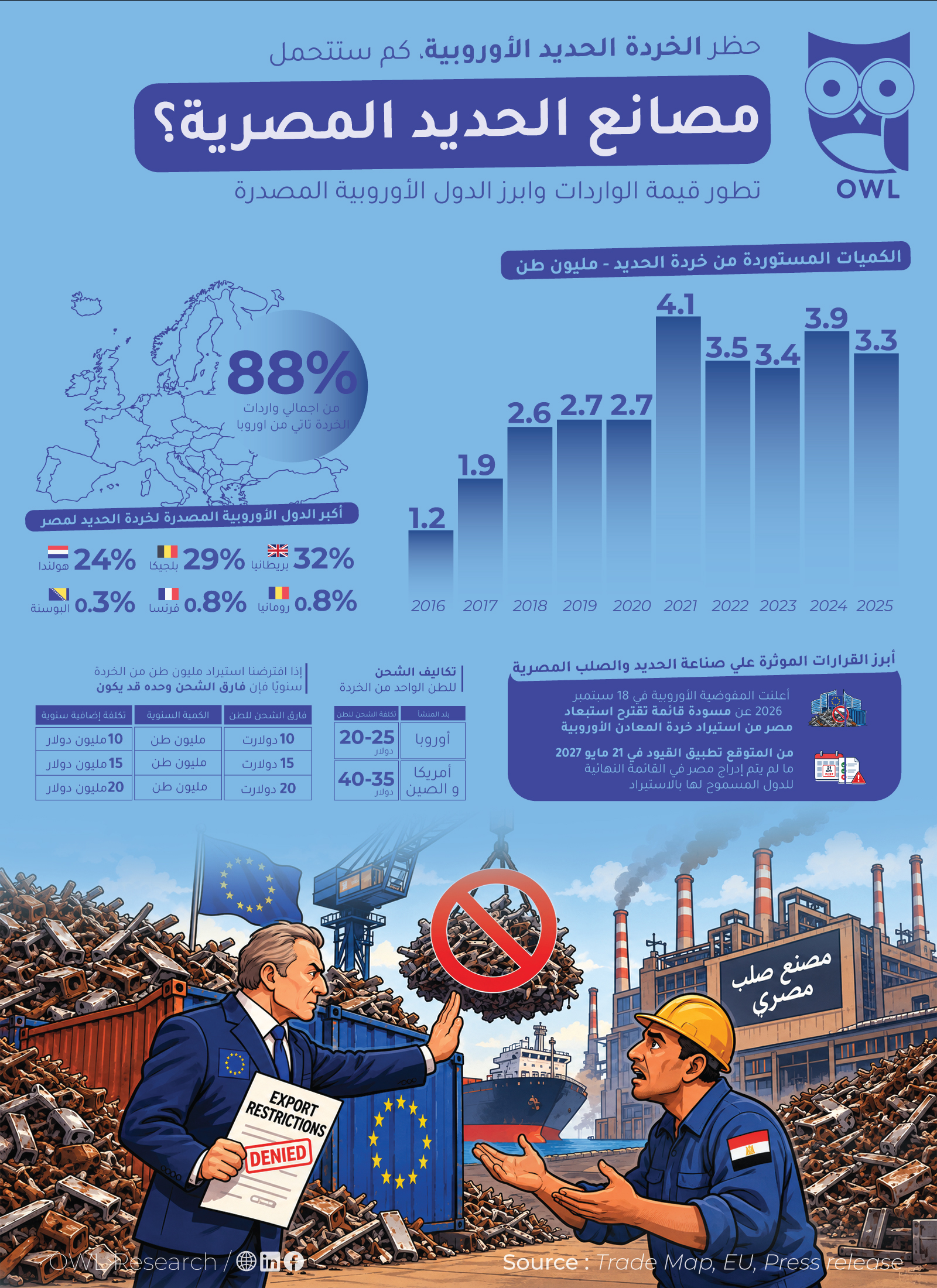
Published on September 18, 2026, the draft list of authorized destinations excludes Egypt from receiving the relevant metal waste streams under the proposed arrangements. If adopted without significant changes, the restrictions would take effect from May 21, 2027, potentially affecting an important source of raw materials for Egypt’s steel producers.
For an industry that relies partly on imported scrap to support steel production, the implications extend beyond trade flows. The proposed changes could influence procurement strategies, shipping costs, production economics, and the competitiveness of Egyptian manufacturers.
Egypt’s Dependence on Imported Steel Scrap
Egypt’s reliance on imported scrap has increased significantly over the past decade, reflecting the importance of external raw material supplies to its steel industry.
According to the figures presented in the OWL Research infographic, Egypt’s scrap imports rose from approximately 1.2 million tonnes in 2016 to 3.3 million tonnes in 2025, peaking at 4.1 million tonnes in 2021.
The data illustrates the scale of Egypt’s demand for imported scrap and the importance of maintaining diversified, reliable supply channels.
European suppliers play a particularly important role. The infographic indicates that approximately 88% of Egypt’s scrap imports originate from Europe, with the United Kingdom, Belgium, and the Netherlands identified as the leading European suppliers.
Recent trade reporting also confirms the importance of European-origin scrap to Egyptian steelmakers. According to industry data cited by EnterpriseAM, Egypt imported approximately 1.86 million tonnes of EU-origin steel scrap in 2025. <Cite refs={[“turn885318search10″,”turn885318search1”]}/>
This concentration makes changes in European export policy particularly relevant to Egyptian manufacturers.
Which European Markets Supply Egypt?
The infographic identifies three major European suppliers:
- United Kingdom: 32%
- Belgium: 29%
- Netherlands: 24%
Other European suppliers include Romania, France, and Bosnia, although their individual shares are considerably smaller.
These relationships reflect established trade routes that connect European scrap collection and processing networks with Egyptian steel manufacturers.
However, the distinction between EU and non-EU suppliers is critical. Belgium and the Netherlands are EU member states and would fall within the proposed EU restrictions. The United Kingdom is outside the EU and is not directly covered by the same EU export authorization framework.
This distinction could become increasingly important as Egyptian buyers reassess their sourcing strategies and explore alternative suppliers.
Why Is the European Union Proposing Restrictions?
The EU’s revised Waste Shipment Regulation aims to strengthen oversight of waste exports and ensure that exported materials are managed in an environmentally sound manner.
Under the framework, exports of non-hazardous waste to non-OECD countries will generally be restricted from May 21, 2027, unless the destination is authorized for the relevant waste stream.
The European Commission published a draft list of authorized destinations in September 2026. Egypt was excluded from receiving the relevant metal waste streams in the draft, creating uncertainty for businesses that depend on European-origin scrap. <Cite refs={[“turn885318search7″,”turn885318search5”]}/>
The measure forms part of a broader regulatory effort rather than a policy directed exclusively at Egypt. Nevertheless, its potential impact on individual countries will depend on their eligibility under the final rules, the classification of traded materials, and the availability of alternative suppliers.
The draft status is important: the final regulatory outcome should not be treated as settled until the relevant measures have been formally adopted.
The Potential Impact on Egypt’s Steel Manufacturers
If access to EU-origin scrap is restricted, Egyptian steelmakers may need to adjust procurement strategies and replace some existing supply volumes with material from alternative markets.
Three potential effects deserve particular attention.
1. Higher Procurement and Shipping Costs
Replacing established European supply routes could require buyers to source material from more distant markets.
The OWL Research infographic estimates shipping costs of approximately $20–25 per tonne for European-origin material and $35–40 per tonne for supplies from the Americas and Brazil.
Based on these illustrative freight assumptions, the additional shipping cost could range from $10 to $20 per tonne, depending on the alternative supplier and route.
For a hypothetical annual shipment of one million tonnes, this would translate into an additional $10 million to $20 million in freight costs.
These figures represent a scenario based on the infographic’s assumptions, rather than a forecast of actual future costs. The final impact would depend on freight rates, supplier availability, material quality, and procurement terms.
2. Increased Competition for Alternative Supply
A shift away from European-origin scrap could increase demand for material from other exporting countries.
Potential alternatives include suppliers in the United Kingdom, the United States, and other international markets, although availability, shipping economics, and competing demand would determine how easily these sources could replace existing volumes.
Egyptian manufacturers may therefore face greater competition for suitable grades of scrap, particularly if other affected importing countries pursue similar sourcing strategies.
3. Pressure on Production Economics
Higher raw material and transportation costs could put pressure on steelmakers’ operating margins.
The degree of exposure would vary by production model, sourcing flexibility, and reliance on scrap as a feedstock. Manufacturers with diversified supply arrangements may be better positioned to adapt than those heavily dependent on a limited number of European suppliers.
Any sustained increase in input costs could also influence pricing decisions and the competitive position of domestically produced steel.
What Should Egyptian Steelmakers Do Next?
The potential restrictions highlight the importance of proactive supply chain management.
Diversify supplier networks. Manufacturers should assess alternative sources and establish commercial relationships before existing supply arrangements are disrupted.
Reassess procurement economics. Buyers should compare the full delivered cost of alternative materials, including freight, insurance, quality specifications, and financing requirements.
Strengthen inventory planning. Businesses should evaluate appropriate inventory buffers and procurement schedules while avoiding excessive working capital commitments.
Monitor regulatory developments. The final EU authorization list, material classifications, and implementation requirements will determine which trade flows are affected and when.
Improve resource efficiency. Better scrap recovery, sorting, and processing can help manufacturers improve material utilization and reduce exposure to external supply shocks.
The Outlook: A Supply Chain Challenge, but Also a Strategic Turning Point
The proposed EU restrictions could represent a significant change for Egypt’s steel scrap supply chain, particularly if the final rules limit access to established European suppliers.
Egypt’s historical import volumes and concentration of European supply demonstrate why the issue deserves close attention from steel manufacturers, procurement teams, investors, and policymakers.
The eventual impact, however, will depend on the final regulatory framework and the industry’s ability to secure alternative sources at competitive delivered costs.
For Egyptian steelmakers, the priority is to prepare for potential disruption without assuming that all European supply will disappear or that replacement costs will necessarily increase by a fixed amount.
The key strategic question is whether Egypt can diversify its scrap supply and strengthen procurement resilience before the proposed restrictions become applicable in May 2027.