Iran has developed one of the most extensive drone programs in the Middle East, building a diverse fleet that includes reconnaissance, surveillance and attack-capable unmanned aerial systems.
Over the past decade, Iranian drones have become an increasingly important component of the country’s military strategy, while also attracting growing international attention because of their reported use and proliferation across regional conflicts.
A Diverse Range of Unmanned Systems
Iran’s drone portfolio includes platforms designed for different military roles and operational requirements.
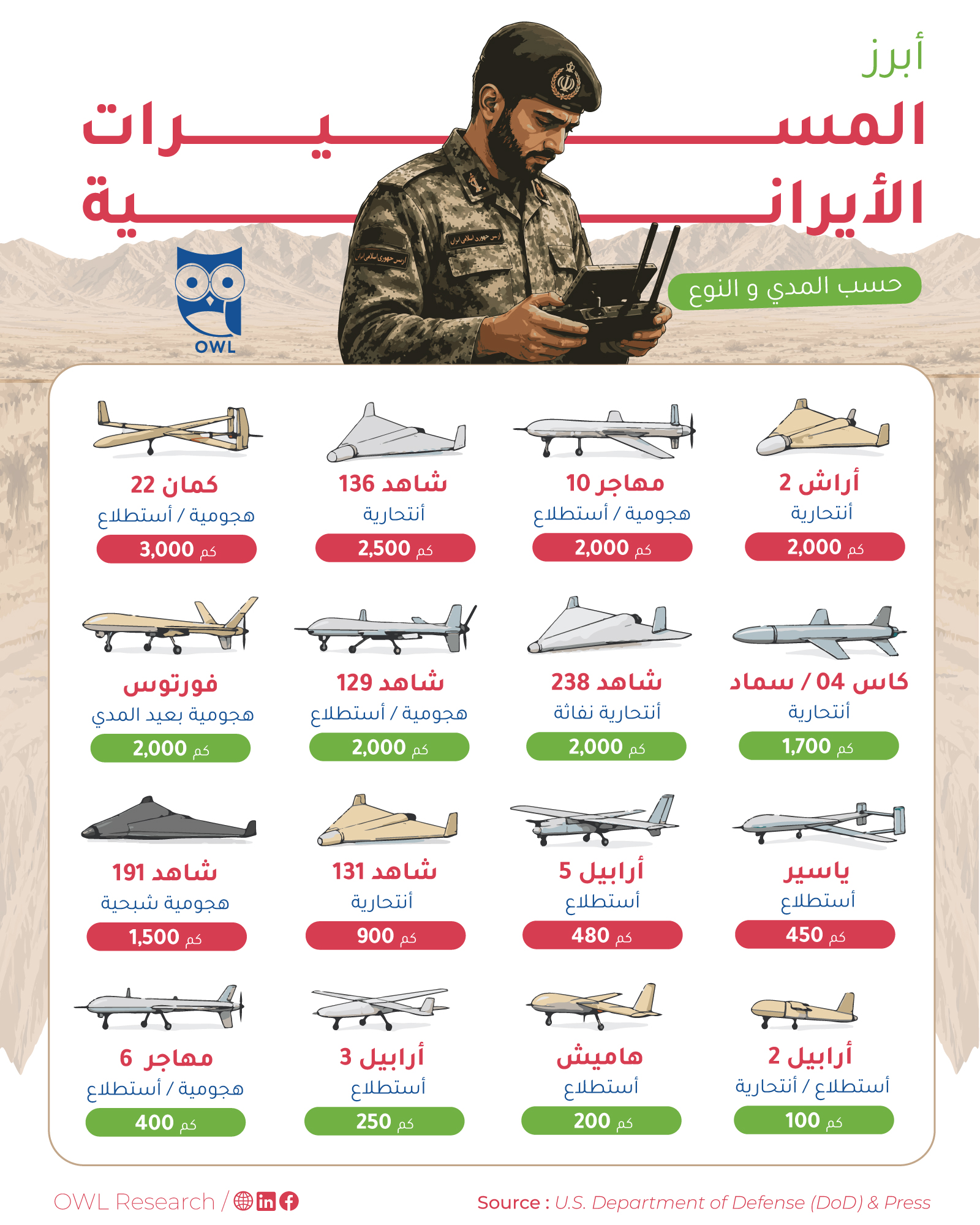
The systems highlighted in our analysis range from relatively compact reconnaissance platforms to larger unmanned aircraft designed for longer-range missions.
Among the systems featured are the Arash-2, Mohajer-10, Shahed-136, Shahed-129, Shahed-238 and Fotros, alongside other Iranian-developed platforms.
Their reported ranges vary considerably, illustrating the breadth of Iran’s unmanned aviation capabilities.
From Surveillance to Long-Range Strike
One of the defining characteristics of Iran’s drone program is the diversity of missions supported by its platforms.
Some systems are primarily associated with reconnaissance and surveillance, providing intelligence and battlefield awareness.
Others are designed for attack or long-range missions, reflecting Iran’s broader effort to integrate unmanned systems into its military capabilities.
This diversification allows drones to perform roles that were traditionally dependent on more expensive manned aircraft.
The Shahed Family
The Shahed series has become particularly prominent in discussions surrounding Iranian drone technology.
Different variants have been developed for different purposes, ranging from reconnaissance to attack missions.
The Shahed-136, for example, has received significant international attention because of its reported use in the Russia-Ukraine war and its association with Iran’s broader drone technology ecosystem.
The continued development of the Shahed family demonstrates how Iran has focused on producing relatively scalable unmanned systems as part of its wider defence strategy.
Why Drones Matter to Iran’s Military Strategy
The importance of drones extends beyond individual aircraft.
Unmanned systems can provide military planners with additional capabilities while reducing the risks associated with putting pilots directly into contested environments.
They can also offer a potentially more cost-efficient way of expanding surveillance and strike capabilities compared with traditional manned aviation.
For Iran, this has made drone development an important element of its broader strategy for strengthening asymmetric military capabilities.
A Regional and Global Impact
Iran’s drone program has implications beyond its own military forces.
Iranian-designed or Iranian-linked unmanned systems have increasingly become part of wider discussions around regional security, military technology proliferation and geopolitical competition.
The spread of drone technology has also changed the strategic environment across the Middle East, where relatively low-cost unmanned systems can influence military planning and security calculations.
This makes the development of Iran’s drone industry relevant not only from a defence perspective, but also from a broader geopolitical and economic standpoint.
The Bigger Picture
Iran’s drone capabilities reflect a broader transformation in modern warfare.
The growing use of unmanned systems demonstrates how military power is increasingly shaped by technology, scalability, intelligence and cost efficiency, rather than relying exclusively on conventional platforms.
As drone technology continues to evolve, countries across the Middle East are likely to place greater emphasis on unmanned systems as part of their defence strategies.
OWL Research Perspective
At OWL Research, we track the technological and geopolitical developments shaping markets and societies across the region.
Iran’s expanding drone capabilities provide an important case study in how defence technology can reshape regional security dynamics and military strategy.
The evolution of these systems also highlights a wider global trend: the future of military aviation is becoming increasingly unmanned.
The battlefield is changing, and drones are becoming an increasingly important part of it.